Taxis on Fuerteventura – arrive stress-free, without a hire car
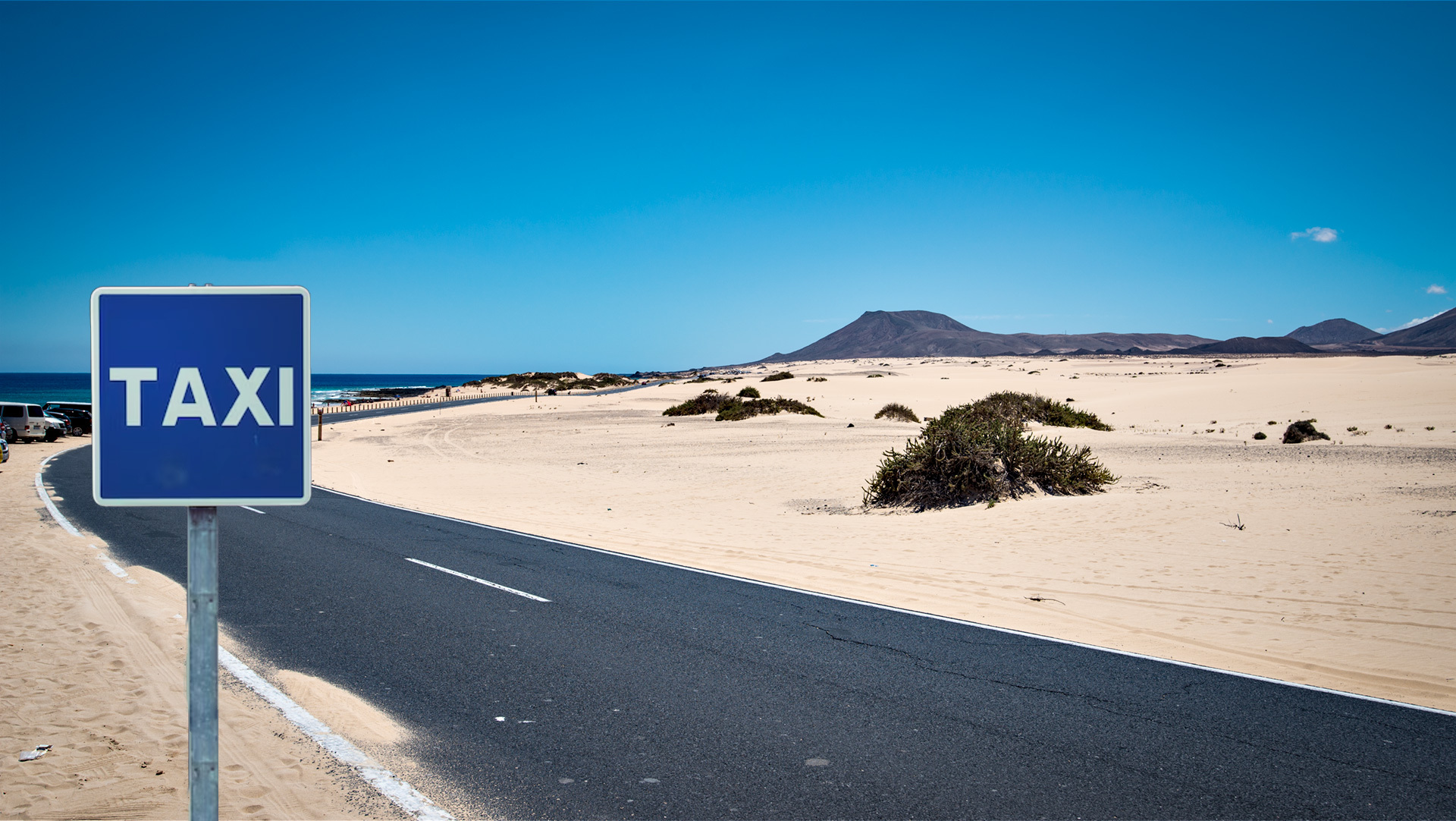
Arrival at Fuerteventura Airport. Outside, the air shimmers over the tarmac, the wind smells of salt and volcanic rock, and your first thought isn’t of the beach – but of the question: how do I get to my hotel now? If you haven’t booked a hire car on Fuerteventura, the taxis on Fuerteventura offer a reliable and hassle-free alternative. The taxi ranks are located in every major town on the island as well as right at FUE Airport – so you won’t have to search for long.
Fuerteventura taxi fares 2026: When do the different prices apply?
Taxi fares on Fuerteventura are state-regulated and calculated using a taximeter – transparent, binding and the same for everyone. For 2026, there are two official fares, which depend on the time of day and the day of the week.
Fare 1 applies on weekdays from Monday to Friday between 06:00 and 22:00 – except on public holidays. The basic fare is approximately €3.50 to €4.50, whilst the price per kilometre is around €1.05 to €1.10.
Tariff 2 – the more expensive of the two – applies at night (22:00 to 06:00), at weekends and all day on public holidays. Here, the base fare starts at €5.00 to €6.00, whilst the price per kilometre rises to €1.20 to €1.30.
Important public holidays in 2026 on which Tariff 2 applies all day: New Year’s Day (1 January), Epiphany (6 January), San José (19 March), Maundy Thursday (2 April), Good Friday (3 April), Labour Day (1 May) and Canary Islands Day (30 May).
Taxi fares from Fuerteventura Airport: How much a journey costs
For journeys starting or ending at FUE Airport, an additional airport surcharge of approx. €1.70 to €2.00 applies. The following guide prices provide an indication for popular routes:
Anyone wishing to travel south to Jandia should also bear in mind that a pre-booked private transfer on Fuerteventura is often cheaper for long journeys than a last-minute taxi from a taxi rank.
Booking a taxi via WhatsApp: the best numbers for each region
Fuerteventura is an island where everything is close by – but where you’ll face long waits if you don’t plan ahead. If you’re planning an airport transfer or a trip to the south, it’s best to book at least 24 hours in advance via WhatsApp. Simply provide your name, date, time, pick-up point and number of passengers – and then wait for the explicit confirmation message before you can feel certain.
The most important taxi WhatsApp numbers on Fuerteventura:
Multi-passenger taxi on Fuerteventura: For groups of 5 or more people
If you’re travelling with more than four people, you’ll need a shared taxi – a minivan which, on Fuerteventura, doesn’t simply wait at the taxi rank but must be booked in advance by phone or via WhatsApp. Providers such as Taxi Costa Calma specialise in this. Please note: A percentage surcharge is often added to the total price for such vehicles.
Taxi journeys on Fuerteventura: Rights, advice & telephone numbers
Taxi drivers on Fuerteventura are generally honest and reliable. Nevertheless, it’s worth staying alert – for example, to check whether the driver is taking an unnecessarily long route. If in doubt: every taxi driver is obliged to carry an official price list (lista de precios) and to present it on request – even before the journey begins.
If you encounter any problems, you are entitled to use the complaints book (libro de reclamaciones), which must be handed over on request. Entries may also be made in German.
Payment: Credit card payments are accepted in almost all taxis – nevertheless, it is advisable to carry some cash for smaller amounts.
An overview of the most important taxi numbers on Fuerteventura:
Whether you’re arriving at the airport after a long journey or heading home after an evening on the beach – a taxi on Fuerteventura will get you to your destination reliably. You just need to know how to book one properly
Every legitimate taxi must have a complaints book (»libro de reclamaciones«), which must be handed over on request. Entries may also be made in German.
Further taxi telephone numbers
Taxi Costa Calma & Pájara: The number +34 928 547 032 is the official switchboard for the Municipality of Pájara. For direct bookings (including via WhatsApp), the number +34 609 274 180 is also frequently used in Costa Calma.
Airport Taxi & Puerto del Rosario: The number +34 928 850 216 is the central number for Taxi Fuerteventura for the capital and the airport.
Taxi Antigua
+34 928 878 011
Taxi Betancuria
+34 928 163 004
Taxi Caleta de Fuste
+34 928 163 004
Taxi Gran Tarajal and the municipality area of Tuineje
+34 928 870 059
+34 928 870 737
+34 928 870 218
Taxi La Lajita
+34 928 161 259
Taxi La Oliva
+34 928 866 108
Taxi Morro Jable
+34 928 541 257
Taxi Pájara
+34 928 547 032
Taxi Puerto del Rosario
+34 928 850 216
Exploring Fuerteventura by hire car – what you need to know about the rules of the road
The roads of Fuerteventura are wide. They wind their way through volcanic rock and windswept plains, passing through sleepy villages and leading up to forgotten viewpoints. If you really want to experience the island, there’s hardly any way round hiring a car on Fuerteventura. But before you get behind the wheel, it’s worth taking a look at the applicable traffic regulations – because Spanish traffic rules apply on Fuerteventura, and they can be quite tricky at times.
Speed limits on Fuerteventura: if you want to drive fast, you need to pay close attention
On the wide autopistas and autovías – the island’s motorways – you’re allowed to drive up to 120 km/h, though in some places the limit is only 110 km/h; the road signs determine the applicable speed limit. If you leave the main road and turn onto a country road outside built-up areas, you’ll be driving at around 90 km/h – a speed that fits in well with the island’s slow pace.
In built-up areas, the roads become narrower: on single-lane roads, the speed limit is 30 km/h; on roads with two or more lanes, it is 50 km/h. Anyone unaware of these differences risks more than just a fine – namely the unease of suddenly not knowing who has right of way at a roundabout. Roundabouts on Fuerteventura are common, and speed camera checks are signposted – but they aren’t always spotted in time.
Parking on Fuerteventura: What the road markings tell you
If you’re parking on a Spanish island for the first time, the road looks like a foreign text. The colours of the markings have specific meanings – and it’s important to know them.
Solid yellow lines send a clear message: no stopping or parking whatsoever. Yellow zigzag lines do at least allow a brief stop – for example, to get in or out of the car. White lines, on the other hand, are an invitation: you’re allowed to park here, usually even for free.
The situation is different with blue lines: these mark short-stay parking zones subject to a charge, where you must purchase a parking ticket. Anyone who forgets this will soon find themselves dealing with the towing service. A particularly common misunderstanding concerns rubbish bins – anyone who parks directly in front of them is almost certain to find that their vehicle is no longer in the same spot.
Right of way, compulsory helmets & prohibitions: the rules you need to know
When driving through a roundabout on Fuerteventura, you must give way to traffic coming from the left. At ordinary junctions in Spain – unless a sign states otherwise – the ‘right before left’ rule applies. It sounds simple, but it’s easy to forget in the hustle and bustle of a holiday.
For anyone travelling by motorbike or moped: Helmets are compulsory – without exception. And whether you’re in a car, on a motorbike or a moped: using a mobile phone without a hands-free kit, as well as wearing headphones whilst driving, is prohibited. Anyone who uses a mobile phone anyway risks a hefty fine.
Seat belts are required by law in Spain – in all seats, for all passengers. And because Fuerteventura is an island we want to protect: throwing objects out of the vehicle is prohibited – this expressly applies to chewing gum or cigarette ends as well. The landscape is too beautiful to litter.
Child seat requirements on Fuerteventura: travelling safely with little ones
Anyone travelling with children on Fuerteventura bears a special responsibility. Children under 12 years of age or shorter than 135 cm – often 150 cm is even recommended – must be transported in the rear seats and must use a suitable restraint system: a child seat or a booster seat.
The front passenger seat is only permitted for children in rare exceptional cases – for example, if the vehicle has no rear seats or if these are already fully occupied by other children. Important to note: if a child seat is used in the front, particularly a rear-facing one, the front passenger airbag must be deactivated – otherwise, the airbag could pose a danger in the event of an accident.
The recommendation is clear: children up to the age of 12 belong in the back seat. That is where they are best protected – and you’ll have a more relaxed journey yourself.
Blood alcohol limit in Fuerteventura: Clear limits on sunny roads
The blood alcohol limit in Spain is 0.5 per mille – this applies equally to most drivers in Fuerteventura. However, anyone who has held a driving licence for less than two years or who is a professional driver is subject to a stricter limit of 0.3 per mille.
The consequences of exceeding this limit are serious. Fines start at 500 euros, and anyone caught driving with a blood alcohol level of 1.2 per mille or more is committing a criminal offence – which may result in the loss of their driving licence or even a prison sentence. Alcohol checks in the Canary Islands are not uncommon; the police carry them out regularly and without warning.
The advice is as simple as it is clear: drinking and driving on Fuerteventura do not mix. The island has plenty to offer to round off the evening peacefully on foot – and to enjoy the roads again the next morning with a clear head.
Drive safely, drive carefully – and let the scenery of Fuerteventura work its magic on you.