
Spanish etiquette: When politeness speaks its own language
There are journeys you undertake with a guidebook – and journeys you only truly understand once you’ve learnt to decipher the unspoken codes of a culture. Spain undoubtedly falls into the second category. Anyone who has ever strolled through the narrow streets of an Andalusian old town, anyone who has breathed in the scent of fresh café con leche and the evening air, will sense that things move at a different pace here. And the people certainly do too.
The vast majority of Spaniards are deeply polite people – and that is precisely what makes so many things so pleasant, yet at times so confusing. They find it noticeably difficult to directly refuse a request. If you ask someone for directions and they reply thoughtfully with “That’s going to be tricky”, this usually simply means that they don’t know themselves. A little lesson in Spanish etiquette that you should take on board early on.
“Is this table free?” – Table manners in Spanish restaurants
In restaurants in Spain, there is an unwritten but ironclad rule: you must never sit down at a table with strangers without asking first. You’ll hardly ever hear the question “Is this table free?” – it simply isn’t part of the repertoire. Instead, you wait in the entrance area until the waiter appears and, with an inviting gesture, suggests a table. In simple eateries, mainly frequented by holidaymakers, these restaurant rules are occasionally relaxed – but anyone wishing to experience the authentic atmosphere should stick to the protocol.
Hospitality in Spain: Warm, but in moderation
It happens surprisingly quickly that you find yourself being invited by Spaniards. A smile, a chat, and suddenly you’re part of the group. However, an invitation to someone’s home is rather unusual – the real hub of social life is in bars and restaurants. People meet up, laugh, have a drink, and soon move on. Spanish hospitality is evident less within people’s own four walls than in the warm flow of company that carries you through the night.
Spaniards like to go out in small or larger groups, which quickly include newcomers. You’re treated like an old friend – and yet you shouldn’t get your hopes up too soon about forming a deep friendship
Paying bills in Spain: One person pays, everyone benefits
Anyone used to meticulously calculating their own share of the bill at dinner in Germany will be in for a liberating surprise in Spain: Paying separately is simply not the norm in restaurants and pubs in Spain. One person in the group picks up the bill – and next time, it’s someone else’s turn. If you want to come across as confident, pool your money beforehand or split the bill discreetly afterwards.
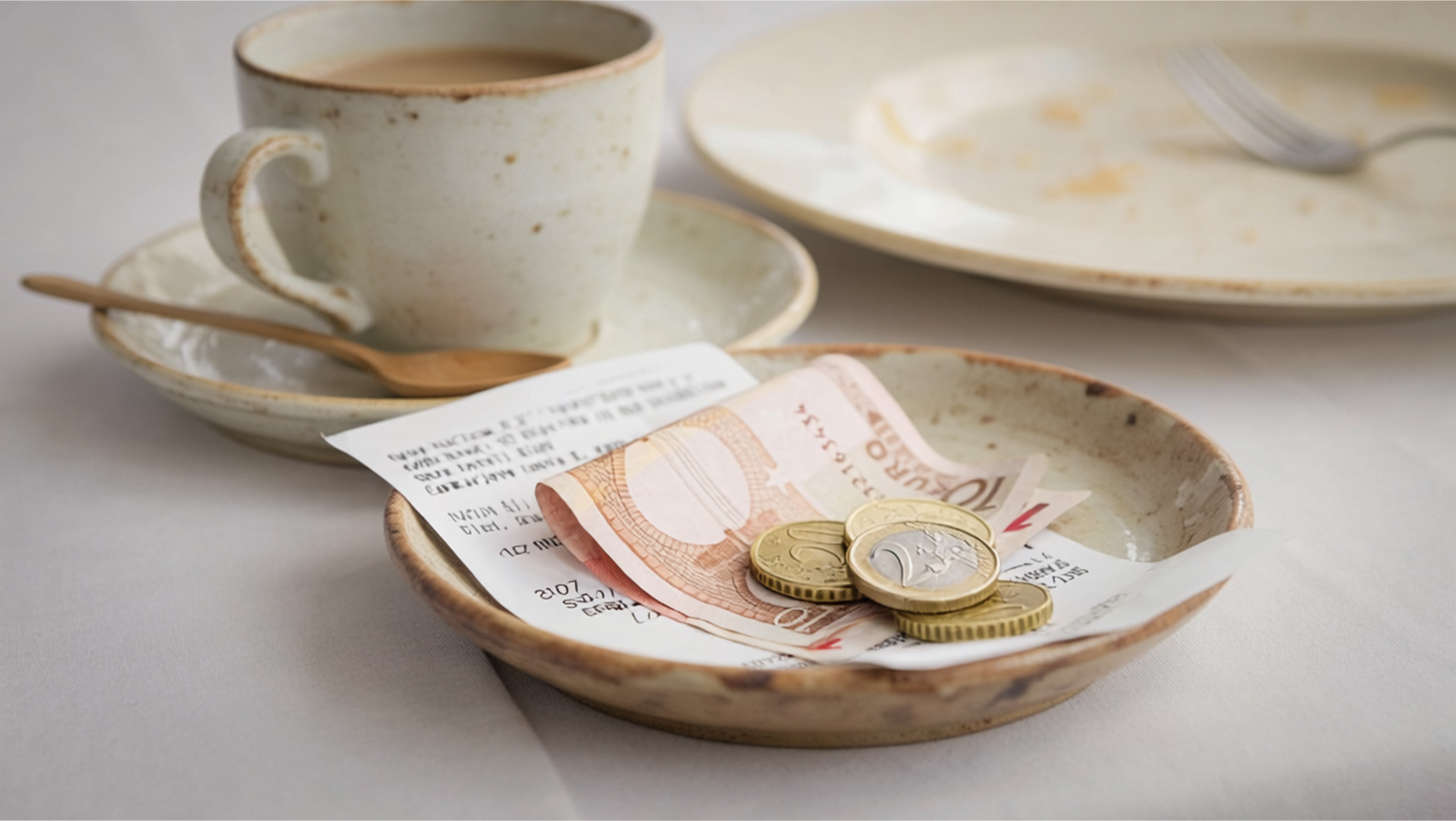
There is always something casual, almost choreographed, about the scene: the bill is requested from the waiter almost in passing, arrives on a small plate, and is briefly examined. Money is placed on the plate, the waiter leaves, then returns with the change. The tip is left on the plate – it is only collected once the whole party has left the restaurant. A quiet act of mutual respect.
When you go from one bar to another – the so-called tapas night is one of the country’s most delightful traditions – someone else will always pick up the tab, almost imperceptibly. As a foreigner, it takes a while to get to grips with the system. But once you understand it, you should do your bit too. It’s a matter of respect.
Tipping in Spain: What is customary
Even though a small service charge may already be included in the price, it is customary to leave a 2 to 5 per cent tip when paying. When paying taxi drivers in Spain, it is customary to round up generously. And if you’re looked after by a housekeeper or a tour guide whilst on holiday, you can assume that they’ll also appreciate a small token of appreciation.
Clothing in Spain: Appropriate, always
A lot is allowed on the beach – but topless sunbathing, although commonplace amongst tourists, is frowned upon by Spaniards. Nude beaches in Spain are clearly signposted and easy to find.
Anyone wishing to visit a church in Spain should not wear shorts or off-the-shoulder dresses. Respect for the place is shown through one’s attire. And even outside places of worship, importance is attached in Spain to appropriate attire: beachwear and a scruffy look are simply out of place in restaurants and shops in city centres. The Spanish are polite enough to turn a blind eye to this – but it’s still best to avoid it.
Travelling around Spain is about more than just sun and sangria. It means immersing yourself in a culture that sees politeness not as an empty phrase, but as a way of life. Anyone who knows the subtle rules of this Spanish etiquette guide will not only be greeted warmly – they will truly be made to feel welcome.