
Island & Nature Fuerteventura: 20 Million Years of Geology, UNESCO Biosphere and Pristine Wilderness
Fuerteventura is one of the oldest islands in the world – and its nature carries this history visibly within it. Around 20 million years old, formed from the ocean floor through volcanic activity, shaped by winds, salt spray and an aridity that feels almost African: Fuerteventura’s landscape is a unique geological and ecological work of art. Since 2009, the entire island has held UNESCO Biosphere Reserve status – a distinction that acknowledges the delicate balance between people and nature. Despite the arid climate, life here is extraordinarily diverse: tabaibas and vast cardones dominate the plains, sea turtles lay their eggs on deserted beaches, and endemic bird species such as the Fuerteventura stonechat are found nowhere else. The Istmo de la Pared, the narrow waist between the dunes and the cliffs. The volcanic chain in the north. The rocky massif of Jandía. In this section, you’ll discover what makes Fuerteventura so remarkable beneath the surface.
Fuerteventura: More Than Sand & Surf – The Island Nobody Really Knows
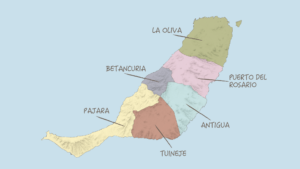
Fuerteventura is far more than a postcard subject. Those who look deeper than the horizon discover a cosmopolitan, growing community – with a clear structure, a diverse population and an economy that is reinventing itself.
Calima – When the Sahara Swallows the Canary Islands
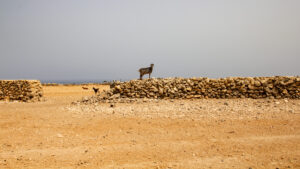
You feel it before you see it: the air grows heavier, the horizon dissolves into a pale orange-brown, and the wind carries a fine, all-pervading dust with it – welcome to the Calima. This distinctive weather phenomenon on the Canary Islands has its origins deep in the African Sahara.
The History of Fuerteventura: A Journey Through the Ages
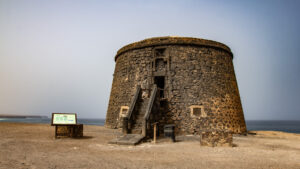
There are places older than their names. Fuerteventura is one such place – an island where the wind sweeps not only through the dunes but also through the millennia. Anyone who wants to understand the history of Fuerteventura must look far back – to a time when no European had yet dared to venture onto the open sea.
The Flora of Fuerteventura – Survival as an Art Form
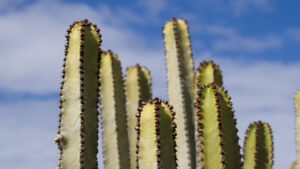
To the first-time visitor, Fuerteventura may appear barren – almost lunar in its raw stillness. Yet those who look more closely, who take their time and let their gaze drift slowly across rocks, dunes and dry hillsides, begin to understand: the plant life of Fuerteventura is no deficiency – it is a masterpiece of adaptation.
Istmo de la Pared: Fuerteventura’s Narrow Waist Between Dunes, Cliffs and the Atlantic
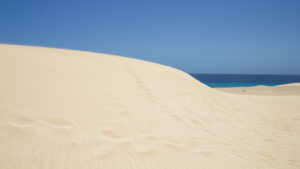
There is a moment, when you look out across the flat plain of the Istmo de la Pared and the horizon dissolves into the sea on both left and right, in which you understand how thin the thread is that holds this island together.
Fauna Fuerteventura: What to Expect in the Island’s Wilderness
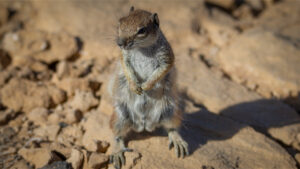
You’re standing on a lava ridge, the wind warm against your face – and suddenly something darts across the rock. In a flash. Silently. Perfectly camouflaged. Welcome to the wilderness of Fuerteventura. The island has a reputation for being barren, empty. But those who look closely encounter genuine nature – raw, surprising and sometimes breathtaking.
Fuerteventura: The Atlantic’s Oldest Wild
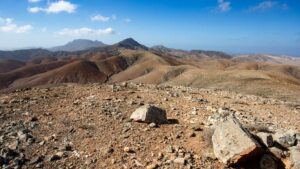
The island stretches roughly 100 kilometres from north to south-west, sometimes 31 kilometres wide, sometimes only five. At its narrowest point – the Istmo de la Pared – a slender strip of land connects the north (Maxorata) and the mountainous south (Jandía). Two worlds, one sandbar between them.
Weather in Fuerteventura – The Island of Eternal Spring
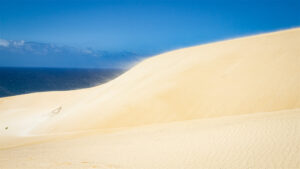
You might think that being on the same latitude as the Sahara would mean scorching heat. But anyone landing on Fuerteventura for the first time is in for a pleasant surprise: the climate on Fuerteventura is mild, dry, and remarkably stable.
Parque Rural de Betancuria – Where Fuerteventura’s Soul Resides
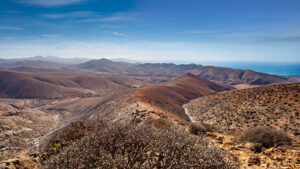
Covering 16,544 hectares – roughly ten per cent of the entire island – this natural park spans the municipality of Betancuria as well as parts of Puerto del Rosario, Antigua, Pájara and Tuineje. As a Parque Rural, or rural landscape park, the area is less strictly protected than a nature reserve.
Parque Natural Islote de Lobos – Where Time Stands Still at the Edge of the Atlantic
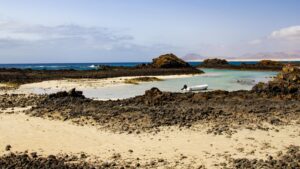
The island of Los Lobos lies at 28° 45′ 0 N and 13° 49′ 16 W, just two kilometres from the northern coast of Fuerteventura, yet it feels like another dimension entirely. With an area of 4.679 square kilometres and a coastline of 13.7 kilometres, it is small enough to explore in a single day.
Parque Natural de Corralejo on Fuerteventura – Where the Wind Reshapes the World
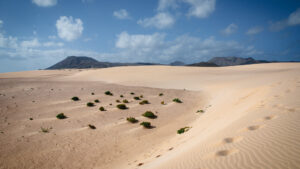
Vast and white and silent, the El Jable dune field stretches out before you – and you need a moment to grasp that you are still on a Canary Island and have not somehow wandered off into the Sahara.
Fuerteventura: Where Sand, Wind and Silence Create Another World
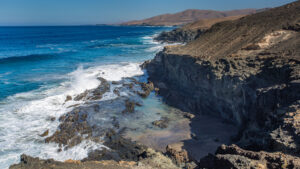
The island wears many faces: rugged volcanic coastlines, turquoise lagoons, quiet villages with Canarian townhouses and buzzing surf beaches. Those who want to discover Fuerteventura encounter a landscape that unfolds like a quiet story – page by page, stretch of coastline by stretch of coastline.
The Most Beautiful Places on Fuerteventura – Where the Island Shows Its True Face
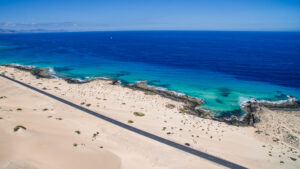
First-time visitors taxiing along Fuerteventura’s runway, gazing at the endless ochre-brown of the plains, might wonder what makes this island so special. Barely any green, barely any shade – and yet people from all over the world keep coming back.
Parque Natural de Jandía: Where Fuerteventura’s Wild Soul Dwells
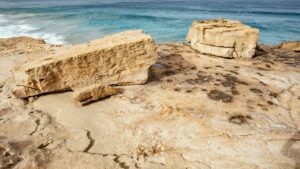
Anyone who sets foot on the Jandía Peninsula for the first time quickly senses that something extraordinary lies hidden here. The Parque Natural de Jandía, stretching across more than 14,900 hectares at the southern tip of Fuerteventura, is no ordinary nature reserve. It is a place where time seems to pass more slowly – where wind and lava and millions of years have together shaped a landscape unlike any other.
Fuerteventura Landscapes: Dunes, Volcanoes and Remote Peaks
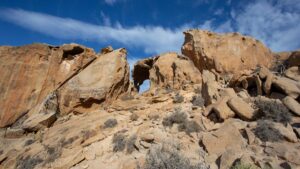
The second-largest of the Canary Islands greets you not with lush greenery, but with a quiet, almost meditative expanse – ochre, beige, grey. A Fuerteventura landscape that does not impose itself, but waits. One you must first come to understand before it draws you under its spell.