
Excursions on Fuerteventura: Volcanoes, History and Natural Wonders Beyond the Beach
Anyone who only knows Fuerteventura from the beach does not truly know the island. The interior, the mountain ridges and the wild cliff coastlines conceal some of the most impressive sights on the entire Canary Islands – and hardly any of the tourists who stretch their legs in Corralejo or Morro Jable have any idea what awaits just a few kilometres inland. Villa Winter, the island’s most enigmatic building. The Casa de los Coroneles in La Oliva, the most imposing colonial manor house in the Canaries. The Calderón Hondo, a volcanic crater you can walk around on foot. The lava tunnel Cueva del Llano with its endemic cave fauna. And Betancuria, the oldest capital of the Canary Islands, nestled in a quiet mountain valley. In this section we introduce you to the best excursion destinations on Fuerteventura – with everything you need to know before your visit.
Aloe Vera Exclusive Tiscamanita – Where the Desert Heals
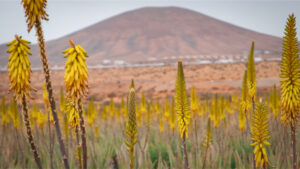
Stretching out in every direction around the building are endless fields of ruler-straight rows of Aloe Barbadensis Miller – the variety native to East and Southern Africa that has become Fuerteventura’s most important cultivated plant.
Road Trip in the North of Fuerteventura – Through Dunes, Tracks and the Silent Heart of the Island
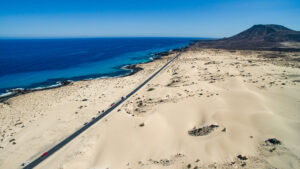
To truly get to know the north, you need to take the wheel yourself, leave the main road behind at some point – and be open to what lies off the beaten track. A road trip through the north of Fuerteventura is not a guided excursion. It is an exploration. With all your senses.
Glass-Bottom Boat Fuerteventura – When the Sea Reveals Its Secrets
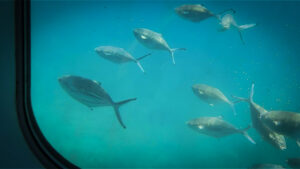
Light filters at an angle through the water. Outside, a ray glides silently on its way, and for a moment you forget everything around you. A glass-bottom boat on Fuerteventura makes exactly that possible: experiencing the silent world beneath the surface – without a diving mask, without wet hair, simply in wonder.
Whale Watching in Fuerteventura – where the Atlantic reveals its secrets
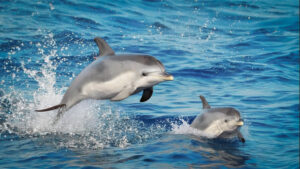
The wind smells of salt, and beneath the keel the deep blue waters of the Atlantic glide past. Anyone on Fuerteventura who views the sea not merely from the beach but ventures out – out into that vast expanse between island and Africa – understands why these waters rank among the most exciting whale-watching destinations in Europe.
Road Trip South Fuerteventura: Dust, Silence and Endless Beaches
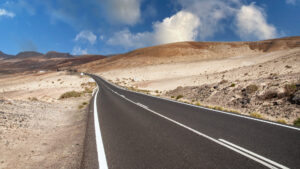
The road trip through southern Fuerteventura is exactly that kind of drive. Around 155 kilometres through volcanic landscape, salt wind and history – from the southern tip of the Jandía peninsula deep into the quiet, almost forgotten island interior.
Road Trip Fuerteventura: 171 Kilometres Through the Wild Heart of the Island
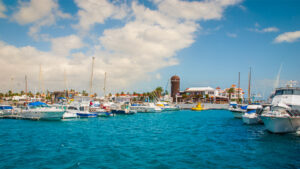
Steering wheel in hand, windows down, a road ahead that seems to lead nowhere – and that is exactly where the real Fuerteventura awaits. Not behind the pool of the nearest resort, not in the souvenir shop. Out there, in the heart of the island, where the roads narrow, the villages shrink, and the stories grow large. This road trip through Fuerteventura covering around 170 kilometres is not a must-do itinerary. It is an invitation to disappear.
Where the Island Holds Its Breath – the Monumento Natural de Montaña Cardón
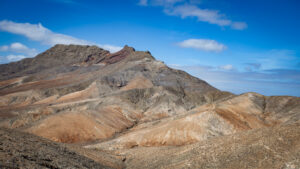
The Monumento Natural de Montaña Cardón covers an area of 1,266.8 hectares and ranks among Fuerteventura’s most significant protected areas. The summit that gives the monument its name reaches a height of 695 metres, making it one of the highest peaks on Fuerteventura.
Monumento Natural de Ajuy: Where Fuerteventura’s Ancient Rock Rises from the Sea
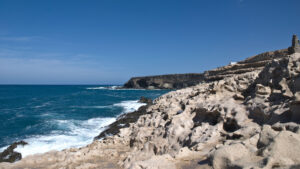
Ajuy – a handful of fishermen’s cottages, black sand, the roar of the surf. But those who pause here and turn their gaze to the cliffs are looking at something older than the island itself. Older than the entire Canary Islands. The Monumento Natural de Ajuy is no ordinary nature reserve. It is a window into an Earth history that began some 120 million years ago.
Mirador de Morro Velosa – Where César Manrique’s Spirit Watches Over Fuerteventura
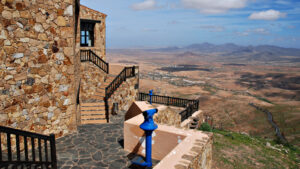
Anyone on Fuerteventura who seeks the feeling of gazing across the entire island will find it here: at the Mirador de Morro Velosa, high up on the volcanic cone of Tegú, at an altitude of around 645 metres. The road winds through a landscape that seems to belong to another age – ochre-coloured slopes, extinct craters, silence.
Mirador de Vallebrón – Where Fuerteventura Shows Its Quiet North
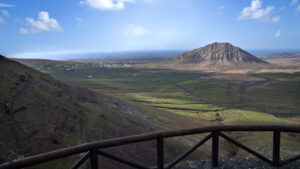
Those who believe Fuerteventura is nothing but wind, desert and white sand beaches will find the Mirador de Vallebrón whispering an entirely different story. A few kilometres south-west of La Oliva, on a remote mountain pass amid the Vallebrón hills, the island opens up like a book.
Degollada de los Granadillos – Where Fuerteventura Is at Its Most Natural
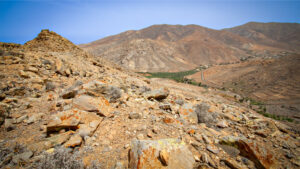
Somewhere between Vega de Río Palmas and Pájara, at an altitude of 479 metres, you inevitably pause – at the Degollada de los Granadillos viewpoint, also known as the Mirador del Risco de las Peñas.
Degollada del Viento – Where the Wind Holds the Silence
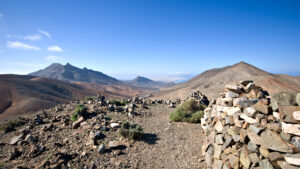
Sometimes you have to escape the beaten track to truly understand Fuerteventura. The Degollada del Viento viewpoint is one of those quiet places that don’t announce themselves – you have to seek them out.
Mirador de Barlovento – Where Fuerteventura Is at Its Wildest
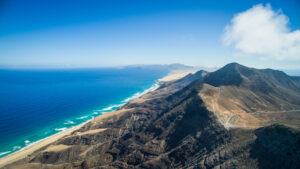
At around 220 metres above sea level, at the far western tip of the Jandía Peninsula, the Mirador de Barlovento rises up – a viewpoint that needs no grand words. Here, the landscape speaks for itself.
Oasis Wildlife Fuerteventura – Where the Desert Comes to Life
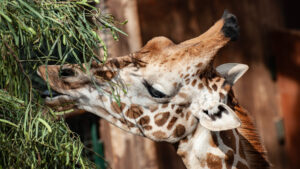
Oasis Wildlife Fuerteventura, formerly known as Oasis Park Fuerteventura or La Lajita Oasis Park, lies near La Lajita, around 30 kilometres north of Morro Jable, and is one of the most impressive nature and wildlife parks in the whole of Europe. Across more than 800,000 square metres it combines a sprawling Botanical Garden with a zoological experience in a class of its own
La Atalayita – Where the Stillness of the Majos Can Still Be Felt Today
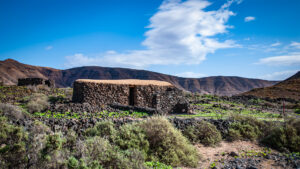
About three kilometres west of the small coastal village of Pozo Negro, nestled amongst the dark lava rock, lies the archaeological site of La Atalayita: one of the most significant and most carefully excavated settlements of the indigenous people of Fuerteventura.
Where the Island Preserves Its Memory – The Fuerteventura Grain Museum
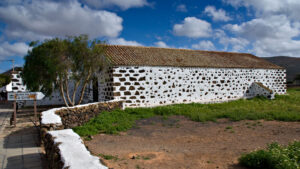
The Museo del Grano la Cilla, the La Oliva Grain Museum, quietly recounts a time when the survival of the people on this island was directly linked to the wind, the rain and the soil.
Calderón Hondo – Where Fuerteventura Reveals Its True Nature
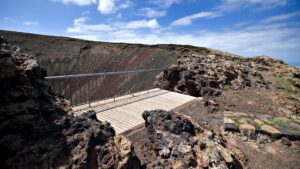
South-west of Corralejo, nestled in a hilly volcanic landscape between La Oliva and the hinterland of the dune town, the Calderón Hondo volcanic crater rises to a height of 278 metres. The name alone hints at what awaits you: a deep cauldron, shaped by forces older than any human memory.
Faro de la Entallada – Where Fuerteventura’s Cliffs Meet the Light
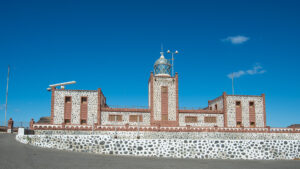
On the south-east coast of Fuerteventura, around seven kilometres east of Las Playitas, a lighthouse has kept silent watch over the sea for decades. The Faro de la Entallada stands where the land breaks off abruptly into the blue of the Atlantic.
Casa Mané – Where Stone, Metal and Colour Meet in the North of Fuerteventura
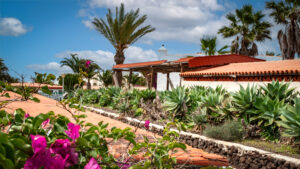
East of the sleepy village of La Oliva in the north of Fuerteventura, Casa Mané seems to rise straight out of the island’s barren lava rock. The 19th-century manor house is home to the Centro de Arte Canario, one of the most remarkable art centres on Fuerteventura – complete with 72 metal goats, world-class Canarian painting and free admission.
Convento de San Buenaventura – Where Fuerteventura’s History Is Set in Stone
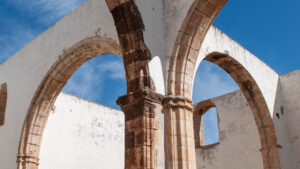
Amidst pale yellow walls and the silence of ancient stones stand the ruins of the Convento de San Buenaventura – the first monastery in the Canary Islands. Those who approach it are not entering an ordinary place. They are stepping into a history deeply engraved in the rock of this island.
Faro de el Tostón – Where Fuerteventura Meets the Edge of the World
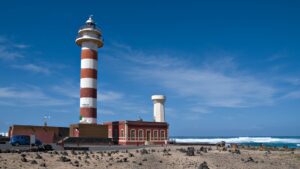
On the north-western edge of the island, north of El Cotillo, the road ends – and silence begins. Here, at the north-western tip of Fuerteventura, stands the Faro de el Tostón: a lighthouse that is more than just a navigational aid. It is a silent witness to the passage of time.
Faro de Jandía – Where Fuerteventura Sinks into the Sea
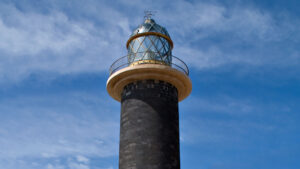
At the westernmost tip of the Jandía Peninsula, where the Atlantic crashes against the rocks with unbridled force, a silent sentinel rises from the rugged rock: the Faro de Jandía. Anyone who has ever seen this lighthouse on Fuerteventura will never forget it. Inside awaits a small museum with the skeleton of a beached sperm whale.
Molino de Antigua – Where the Windmills on Fuerteventura Make Time Stand Still
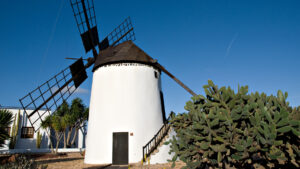
The Molino de Antigua is a tranquil museum complex in the geographical heart of Fuerteventura, where time seems to have stood still since the 18th century. Housed in a restored windmill, the museum is dedicated to traditional gofio production and rural Canarian life, complemented by a rustic restaurant co-designed by César Manrique and a state-run craft shop. A rewarding stop on any island tour for anyone who wants to understand the soul of Fuerteventura.
Casa de los Coroneles – Fuerteventura’s Most Imposing Manor House
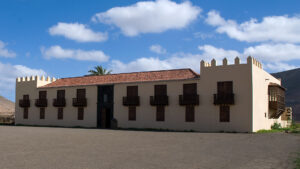
Anyone exploring the northern tip of Fuerteventura will eventually come across the Casa de los Coroneles in La Oliva – a building that stands out against the island’s austere landscape like a reminder of times long past. The House of the Colonels stands somewhat apart from the town centre, lending it an aura of quiet grandeur. Today it is a vibrant cultural centre and one of the most significant historical attractions in the north of Fuerteventura.
Where Stones Speak – The Museo Arqueológico de Betancuria
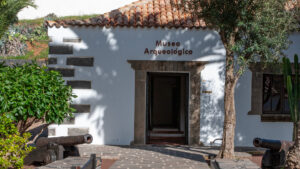
Two cannons at the entrance, palm trees in front, a restored stone house behind – at first glance, the Museo Arqueológico de Betancuria doesn’t make much of an impression. And that is precisely what gives it its charm. Discover the world of the Majos, Fuerteventura’s indigenous people, in the historic heart of the island.