Cycling Tours on Fuerteventura – Where the Wind Sets the Direction
Fuerteventura. The name alone sounds like the start of something. Vast horizons, glowing volcanic rock, a wind that howls on the high ground and falls silent on the climbs – as if watching to see how long the lungs hold out. Anyone who sets out on cycling tours on Fuerteventura will not find a gentle leisure ride. They will find a confrontation. With gradients that make no compromises. With heat that bears down on exposed mountain trails like a second force of gravity. And with a landscape that rewards every drop of sweat.
Three routes. Three characters. All three demand everything.
Cycling Tour through Jandía – Track, Pulse and Volcanic Rubble
Start and Finish: Costa Calma | Distance: approx. 20 km | Elevation: 334 m | Riding Time: 4 hours
The first climb comes early – and it means business.
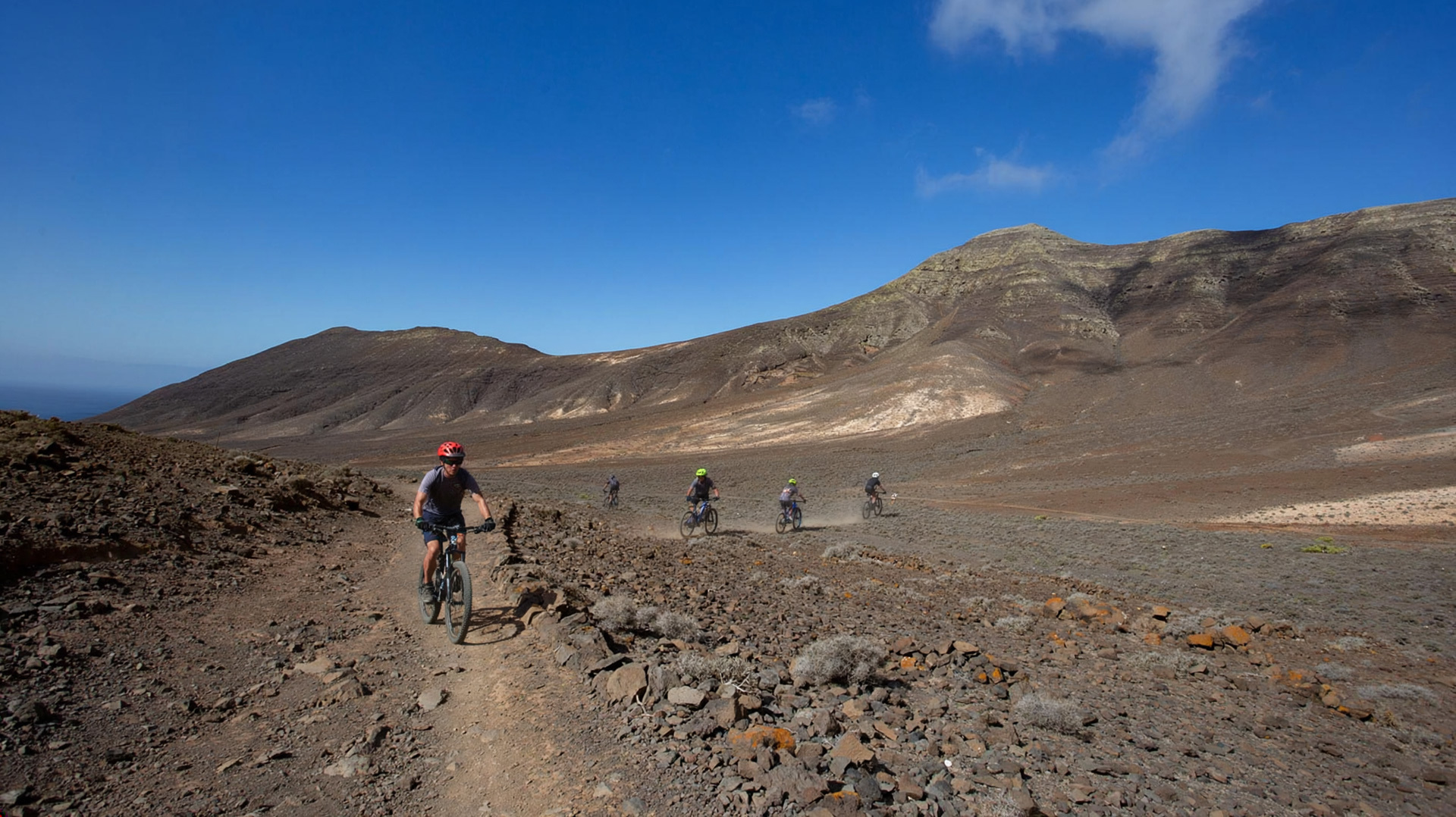
You set off from Costa Calma, initially rolling along the FV-2 towards Morro Jable. The road climbs steadily, the tarmac still offering reassurance. But just after kilometre 73, the real game begins: a track branches off to the right, narrow, dusty, without mercy. This is where the tour changes state – from cycling to physical ordeal.
The track dips down into a barranco, one of those deep erosion ravines that cut through Fuerteventura like old wounds. The descent is deceptive. What goes down must come back up – and the climb out of the right side of the barranco is one of those sections where you get out of the saddle for the first time. The thighs are working. The sun is sharp. The surface alternates between loose gravel and hard rock.
Once at the top, you follow a north-easterly direction along the ridge. The track intermittently disappears into the terrain – no waymarked path, no shade, just your instincts and the GPS track. Anyone riding here in high summer encounters the Canarian heat in the most immediate way: no trees, no buildings, no shelter from the wind. Only the hot easterly wind, sapping both body and morale in equal measure.
After several ridges with accumulated climbing, the track reappears clearly. It heads towards La Pared – the narrow neck of the Jandía peninsula – before a connecting route turns back towards Costa Calma. The return leg rolls freely. But it gives you time to appreciate what you have just accomplished.
Sporting Difficulty: Moderate to challenging. No extreme technical sections, but consistently demanding terrain on loose ground. At temperatures above 30 °C, a moderate route quickly becomes a hard one. Plan for a minimum of 2 litres of water – there is no resupply on the route.
Cycling Tour from Betancuria to Ajuy – Climbing on Ancient Mule Tracks
Start: Betancuria | Distance: approx. 15 km | Elevation: approx. 380 m | Riding Time: 2.5 hours
Anyone who thinks 15 kilometres is a short distance has not reckoned with Betancuria.
The start is already at around 450 metres above sea level – in the mountainous heart of the island, where ancient goat tracks thread the hillsides and the wind smells of sweat and dust even on clear days. You leave Betancuria on the FV-30 towards Pájara and face an early decision: road or track. The track is the right choice – and the harder one.
Running parallel to the FV-30, an old off-road track winds through the rugged terrain that characterises the high plateaux of the island’s interior. The surface is uneven, the line narrow. Those with arm strength and technique in the saddle are in their element here. Those without will learn quickly.
Just before La Vega de Río de las Palmas, one of the most beautiful sections of this cycling route on Fuerteventura begins: you cross the river, keep right, pass the reservoir – an almost surreal sight on such a dry island – and then continue descending. The gradient picks up. The barranco narrows and steepens, and the track demands full concentration. Hands on the brakes, eyes on the surface, back low.
Then the coast. Ajuy. Black rocks, turquoise water, a fisherman mending his net. You stretch out your legs and drink whatever is left in the rucksack.
Extension: The full loop via Pájara – 40 kilometres total distance
Those who tack on the return to Betancuria immediately take on a full day cycling tour on Fuerteventura of around 40 kilometres and over 700 metres of climbing in total. From Ajuy, take the FV-621 to Pájara, then continue on the FV-617 – and from Pájara back up to Betancuria via the FV-30. The final climb is real. The last kilometres back up cost what the earlier descent gave away. A fair exchange.
Sporting Difficulty: Moderate. The track sections demand technical ability. The long descent through the barranco requires active body tension and brake endurance. Anyone tackling the full loop should have mountain biking experience in hilly terrain. Sun protection is absolutely essential on the exposed high-altitude sections.
Cycling Tour to the Pico de la Zarza – The Island’s Toughest Climb
Start: Barceló Hotel, Morro Jable | Distance: approx. 16 km | Elevation: approx. 840 m | Riding Time: 5 hours
840 metres of climbing. 16 kilometres. No shade. No water source. No excuses.
The tour to the Pico de la Zarza – at 807 metres the highest peak on Fuerteventura – is the queen stage among the Hike & Bike tours on Fuerteventura. It begins innocuously: from the Barceló Hotel in Morro Jable you roll upwards on a tarmac road, the surface still smooth, the gradient still manageable. But this is the calm before the storm.
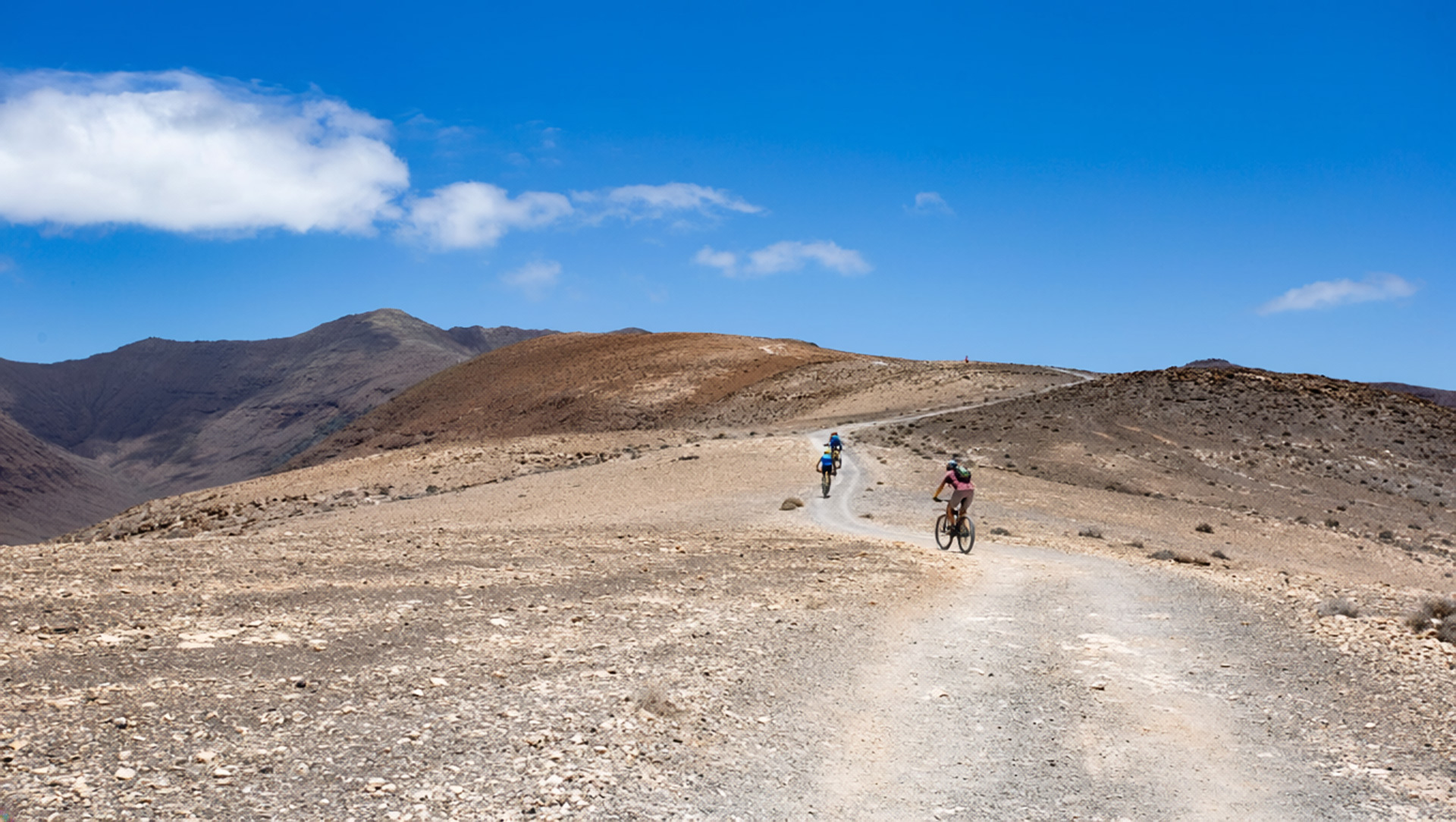
At the water reservoir, civilisation ends. From here a gravel track winds its way up the mountain in switchbacks and long straight sections – relentless, without flat stretches, without recovery. The gradient is consistently in double figures. Anyone riding here in summer fights two opponents simultaneously: gravity and the Canarian midday heat, which heats the dark volcanic rock until the air shimmers above it.
With every metre of altitude, the island opens up further. Below, Morro Jable lies like a scale model. To the left, the Atlantic shimmers. To the right, on the other side of the peninsula, the Laguna de Sotavento comes into view. You look and pedal. Pedal and look. Eventually, only the pedalling remains.
At around 660 metres above sea level, you reach the point where the bike stays behind and the legs carry on alone. The final section to the summit is no longer a cycling path – it is a steep scramble across loose rock, narrow, exposed and windy. Sturdy footwear is not a luxury here but a necessity.
Up top. Summit. Pico de la Zarza.
The wind comes from every direction at once. And you stand at the highest point on Fuerteventura and see the entire island all at once – both coastlines, both oceans, the dunes to the north, the Jandía National Park at your feet. There are moments when exhaustion and triumph are the same feeling. This is one of them.
The descent back to Morro Jable follows the same route. The brakes get warm. So do the forearms. But the mountain lets you go.
Sporting Difficulty: High. This is the most demanding MTB tour on Fuerteventura. The combined burden of constant climbing, heat and rubble terrain makes it a genuine endurance test. Plan for at least 3 litres of water. An early start – ideally before 8 a.m. – will protect you from the worst of the midday heat. Full suspension and wide tyres have a clear advantage on the track.
Cycling on Fuerteventura – What Sportspeople Need to Know
Cycling on Fuerteventura is not a casual leisure activity. It is sport – serious, sweat-inducing, rewarding sport. The island puts up no artificial obstacles. It offers real ones: steep volcanic tracks, rubble sections, long exposed climbs under the Canarian sun.
Best time of year for sporting cycling tours: October to March. Temperatures between 18 and 24 °C make even demanding climbs manageable. In July and August, temperatures on the mountain tracks of Fuerteventura can exceed 40 °C – at which point every tour becomes an extreme undertaking.
Equipment: For all three routes, a full-suspension mountain bike has a clear advantage. Wide tyres with good tread grip far better in loose volcanic gravel. Helmet, knee pads for the technical sections, windbreaker for the summit areas.
Hydration: The dry air in the Canaries conceals actual fluid loss. Those who drink too late will notice too late. Electrolyte supplements make a noticeable difference to hydration levels on long tours in the heat.
Navigation: On the track sections of these cycling tours on Fuerteventura, the route regularly disappears into the terrain. GPS tracks are not a comfort – they are a safety essential.
Conclusion – Fuerteventura rewards those who push through
This island gives nothing away. Anyone who wants to conquer the barrancos, the mountain passes and the high plateaux of Fuerteventura on a bicycle must earn the panorama – metre by metre, contour line by contour line, under a sun that knows no mercy.
But that is precisely where the magic lies. Anyone who reaches the top – the Pico de la Zarza, the coast at Ajuy, back in Costa Calma – has done more than a cycling tour. They have seen the island from within.
Saddle up. Pedals down. The mountain is waiting.