Istmo de la Pared: Fuerteventura’s Narrow Waist Between Dunes, Cliffs and the Atlantic
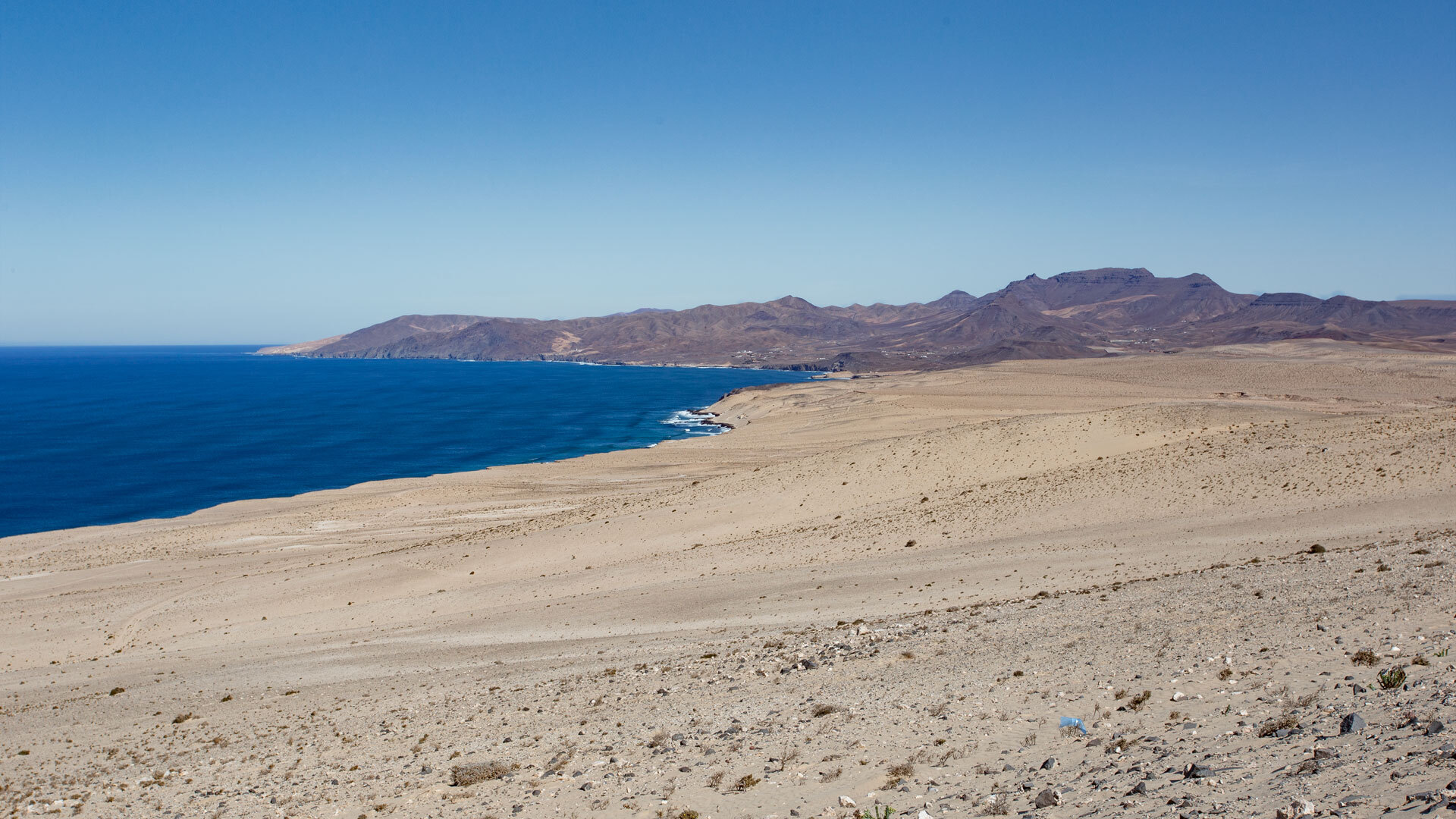
There is a moment, when you look out across the flat plain of the Istmo de la Pared and the horizon dissolves into the sea on both left and right, in which you understand how thin the thread is that holds this island together. Five kilometres of land – no more – separate the Atlantic in the west from the Atlantic in the east. And yet this narrow strip carries within it a landscape that feels larger than its dimensions might suggest: wide, wind-shaped, possessed of a stern yet tender beauty.
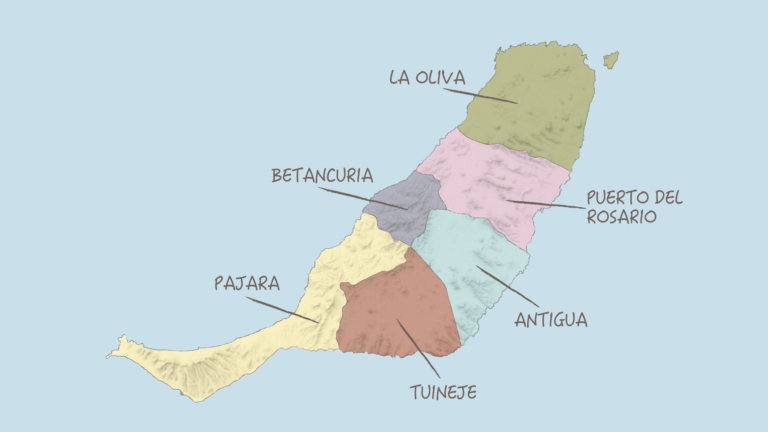
The Istmo de la Pared isthmus is the narrowest point of Fuerteventura. Covering an area of 45 square kilometres and just 4.5 kilometres at its narrowest, it connects the northern part of the island, Maxorata, with the Jandía Peninsula in the south. It is bridge, breath and natural wonder in one.
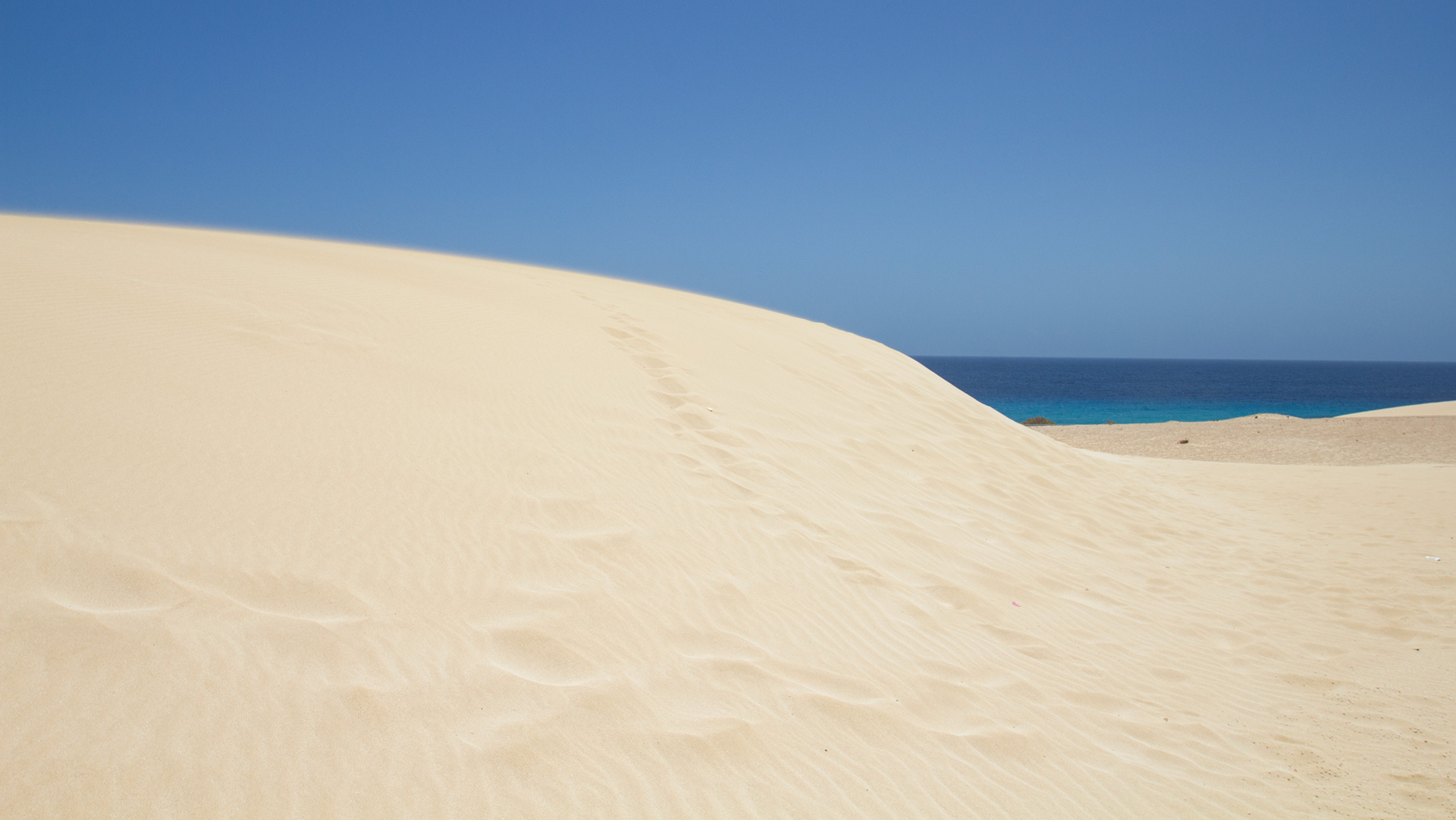
Sand in Motion – The Migrating Dunes of the Istmo
The first thing you notice is the wind. It comes from the north, steady and reliable as an old acquaintance – Fuerteventura’s trade wind, which has swept across this island for thousands of years and shaped its face. On the Istmo de la Pared, its effect is particularly impressive to witness: countless migrating dunes cover the flat terrain, and they really do migrate. Slowly, relentlessly, a little further each day – driven by a wind that never rests.
It is easy to imagine what this Fuerteventura dune landscape might have looked like in earlier centuries: deserted, inaccessible, bounded by the sea on both sides and arched over by sky. Even today the landscape is barely developed. The Parque Natural de Jandía, to which the Istmo belongs, watches over this fragile space and shields it from the encroachment of mass tourism.
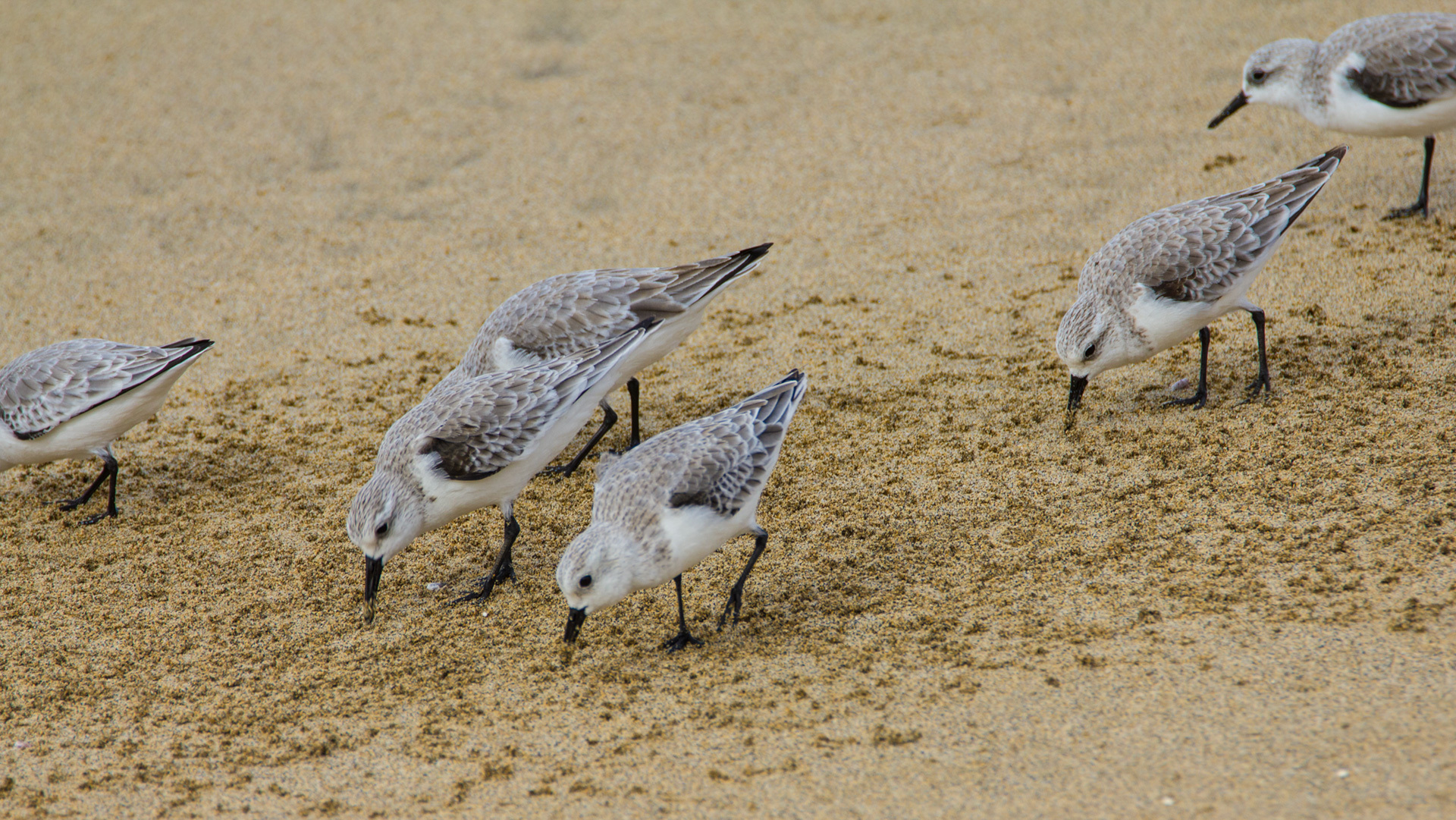
The dunes are not merely beautiful to look at – they are also a habitat. Those who take their time and walk quietly will be amazed at what has made its home in the sand and among the sparse plants.
Life in the Barren – Flora and Fauna of the Istmo de la Pared
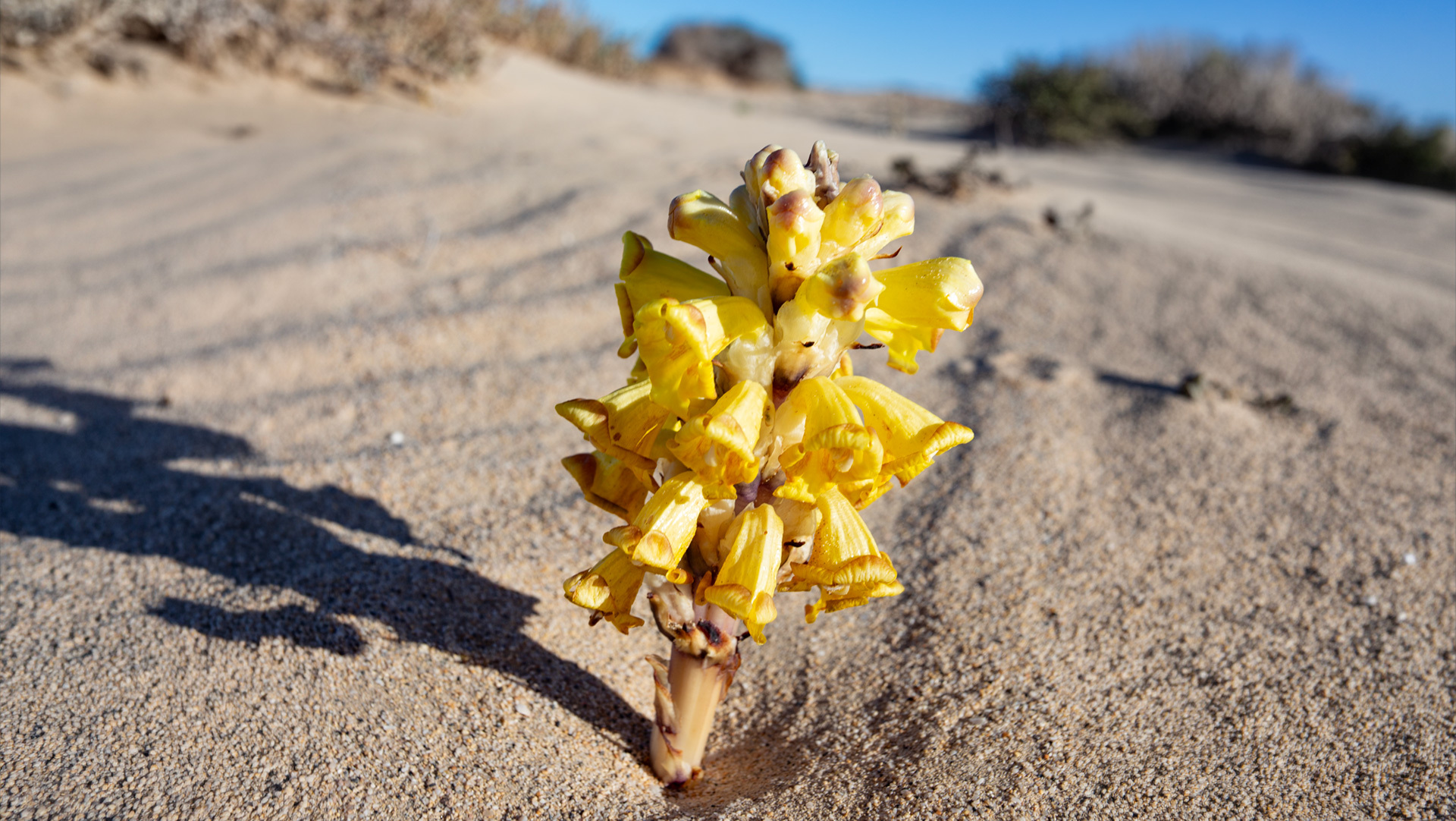
A desert landscape that lives – that is the Istmo de la Pared for those who look closely. Fuerteventura’s arid flora is not lush vegetation, but it is tenacious. Plants such as the prickly lettuce have adapted over many years to the dry, wind-lashed conditions. Their survival strategy: frugality. Minimal leaf surface, deep roots, patience.
The Houbara Bustard – Desert Bird and Natural Jewel
Yet the true star of this landscape flies – or rather strides, for the Houbara Bustard is essentially a runner. Known in Spanish as Hubara, this rare desert bird is considered one of the most fascinating creatures of Fuerteventura and is at home on the Istmo de la Pared.
The Houbara Bustard’s plumage is a masterwork of camouflage: the upperparts shimmer in warm sandy tones, the belly gleams white. What makes the bird truly unforgettable, however, are the long black-and-white feathers that hang from its neck like a fine ruff – and the striking feathered crest on its head, which it raises when excited. Anyone who encounters a Houbara Bustard instinctively holds their breath.
The population of these birds is globally threatened. On Fuerteventura it is actively protected through conservation measures. The Istmo de la Pared is one of the few remaining refuges of this extraordinary desert bird.
When the Desert Blooms
In winter, the Istmo can transform into a different place altogether. Rare rainfall is enough to rouse the seeds sleeping in the dry soil. Within days, the brown-beige plain covers itself with a delicate green of flowering plants – Fuerteventura’s desert bursts into bloom, briefly, magnificently, and all the more impressive for being so unexpected. A spectacle that shows: even in barrenness there lies a hidden abundance.
The Beaches of the Istmo – Raw, Beautiful and With a Dignity All Their Own
The beaches of the Istmo de la Pared are not classic bathing beaches. They are something else – wilder, more unspoilt, less accommodating. And that is precisely what makes them so special.
Playa de la Pared – Dark Sand, Intimate Cove
The Playa de la Pared is one of those beaches you do not easily forget. Just 250 metres long and an average of 20 metres wide, framed by dark, jagged rocks that lend the cove an intimate and almost private atmosphere. The sand is dark, almost black – a contrast to the bright sky and turquoise water that is aesthetically captivating.
Swimming is not recommended here: strong currents and heavy surf on the west coast make the water dangerous. But for sitting, listening and simply arriving, the beach is ideal. At sunset in particular, the cove reveals its full magic – the light strikes the dark rock, the sea glows in red and orange, and for a moment time seems to stand still.
Above the cove there is a small fish restaurant in La Pared, where you can reflect on the day’s impressions over traditional dishes. A simple place, honest food, wide views.
Playa del Viejo Rey – Beach of the Old King
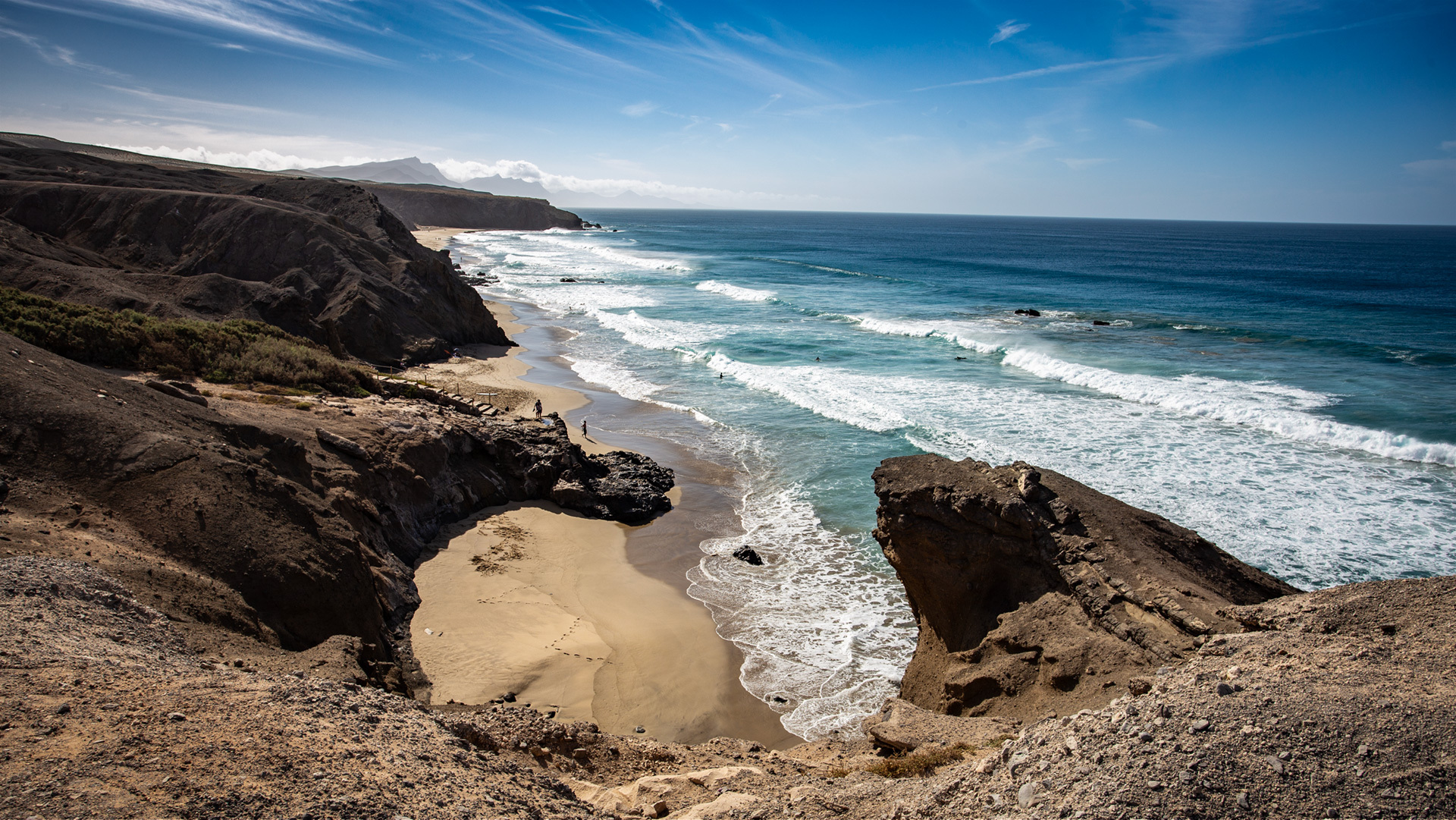
Around 800 metres long, open and wind-shaped: the Playa del Viejo Rey – the “Beach of the Old King” – has a different character to the intimate neighbouring cove. Wide waves roll in, the wind blows strongly and constantly, making this beach a surfers’ beach par excellence. Surfers from all over the world are drawn to the west coast of Fuerteventura, and the Viejo Rey is one of their favourite spots.
In La Pared you can hire surf equipment and book surf lessons – for beginners and more experienced surfers alike. The local La Pared surf school is a fine introduction to the world of waves.
Hidden Beaches in the South
At the southern end of the Istmo de la Pared there are further small coves – some visible only at low tide, hidden between rock and foaming water like well-kept secrets. Those who seek them out will find seclusion in a landscape that redefines the word solitude.
Punta de Guadalupe – Where the Rock Plunges into the Sea
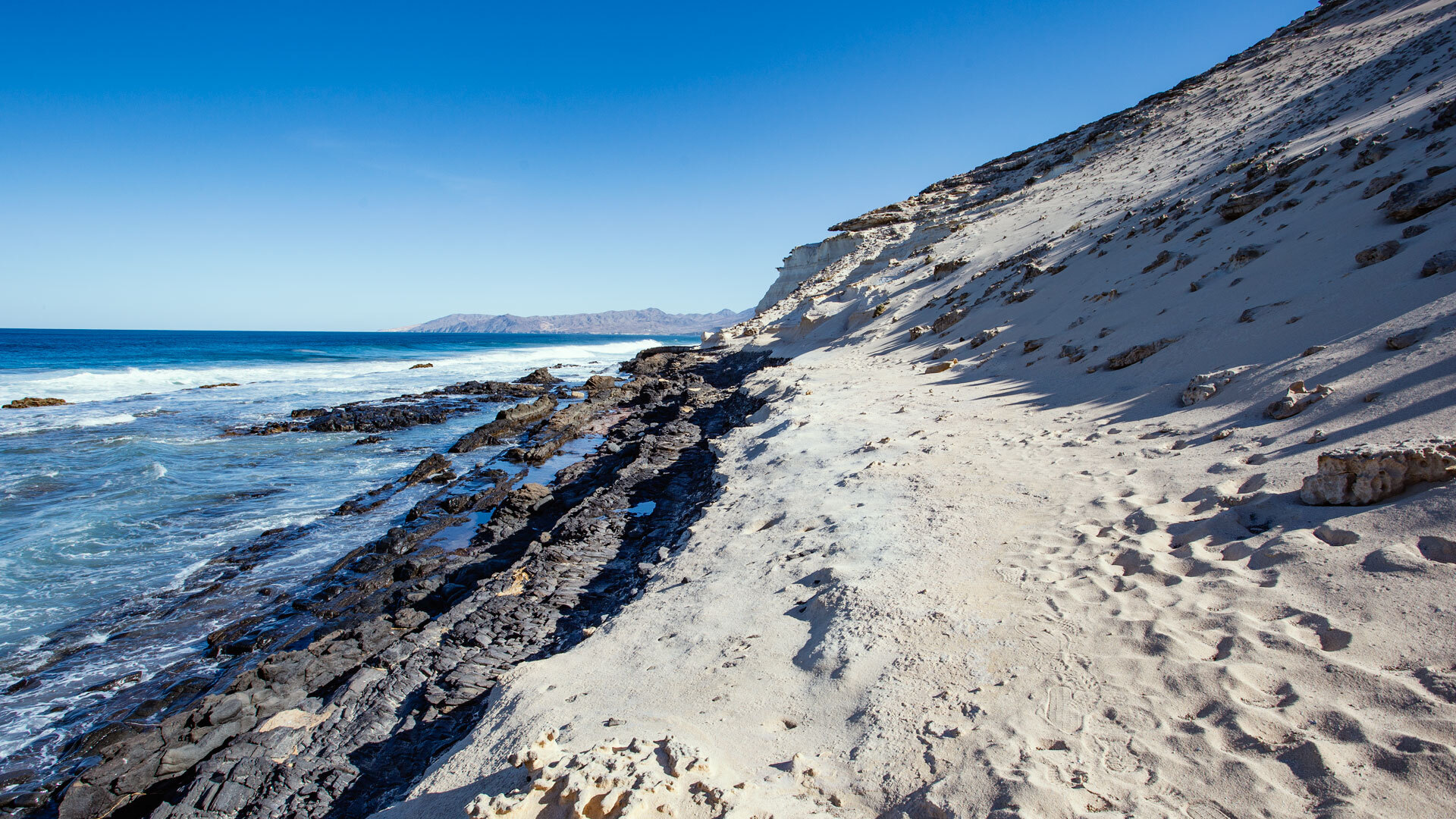
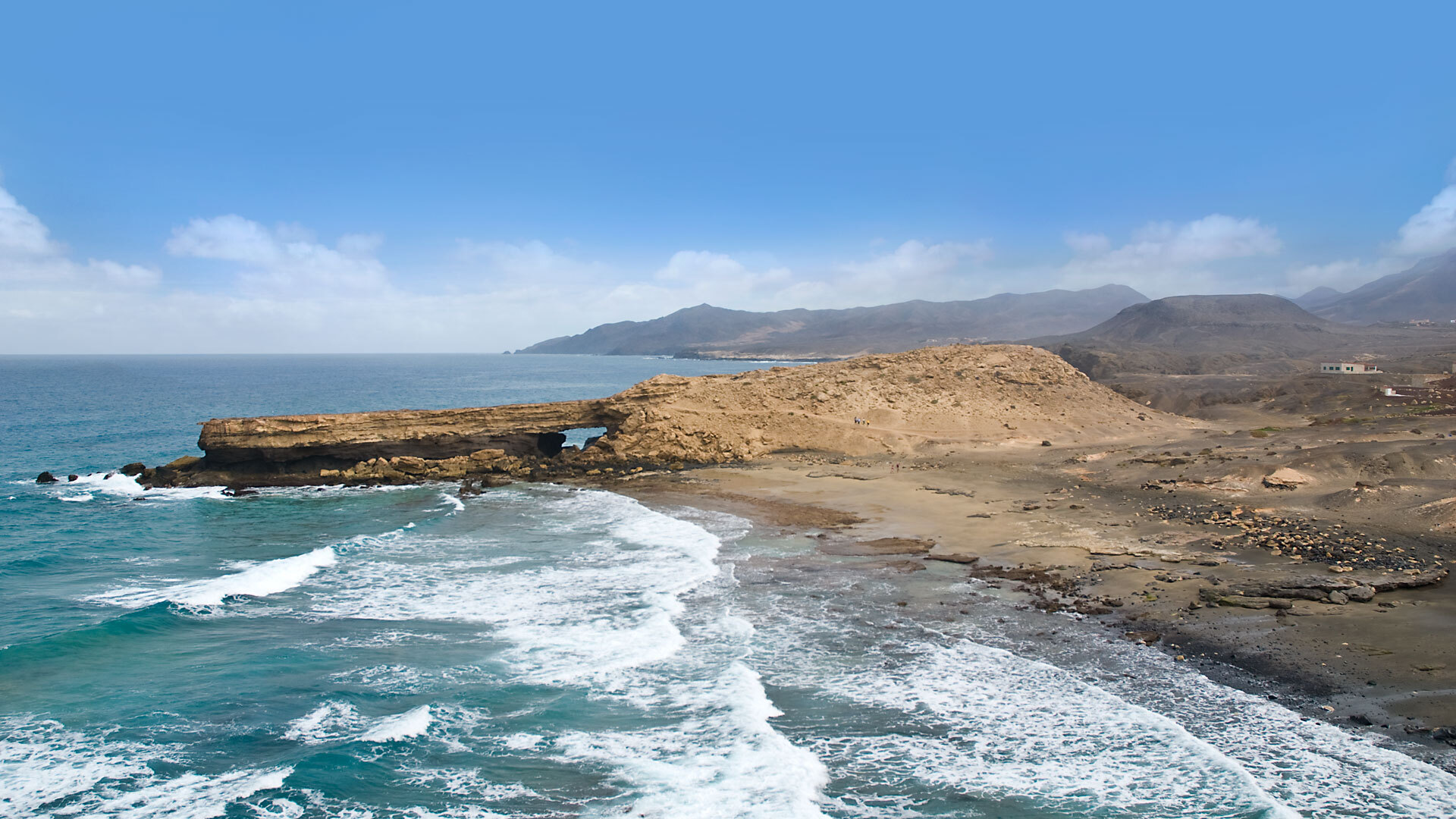
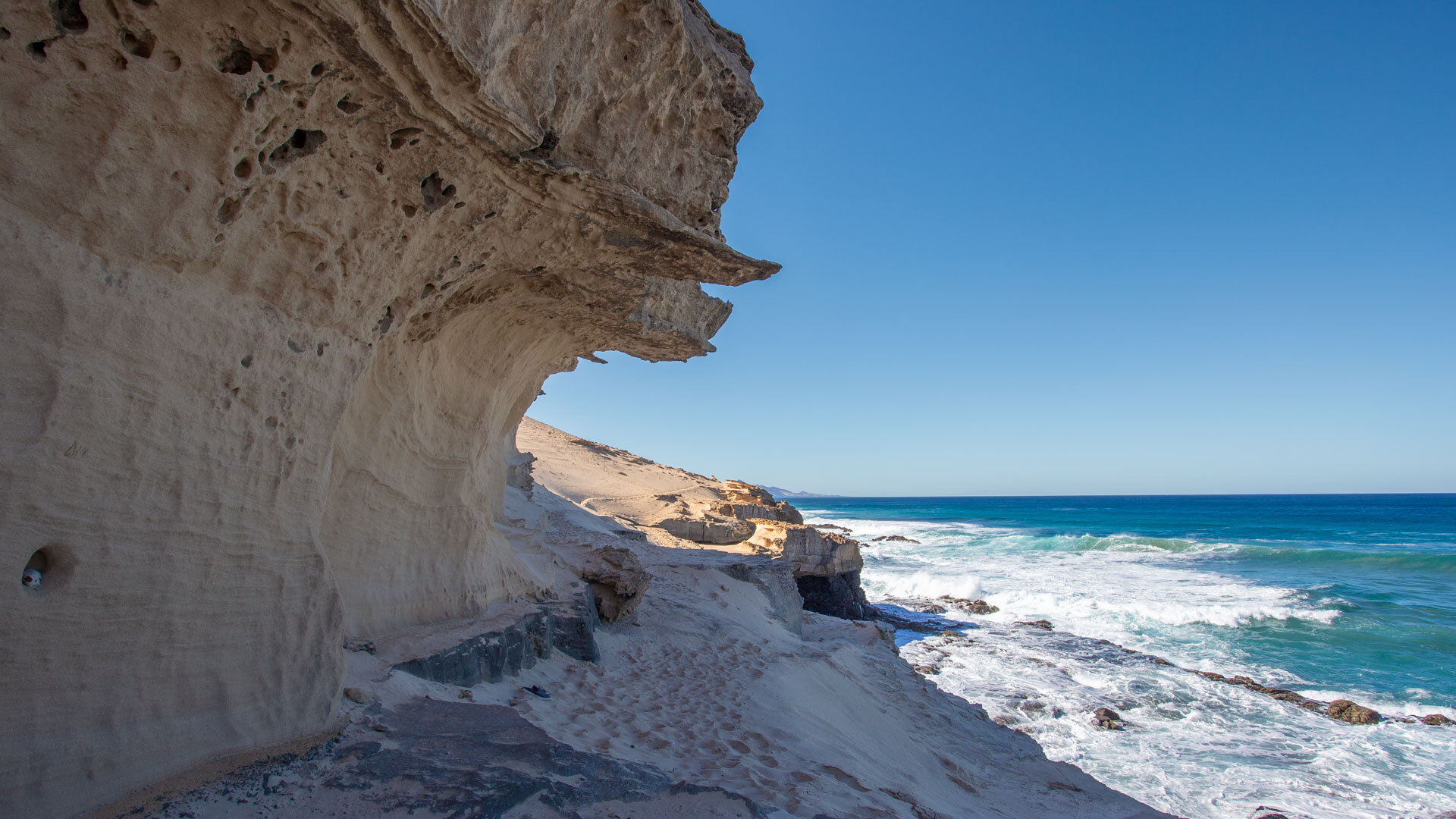
Whoever walks along Fuerteventura’s west coast will inevitably come upon Punta de Guadalupe – a striking rock cliff in the municipality of Pájara, right on the Istmo de la Pared, near the village of La Pared. The pale limestone formation juts far out into the Atlantic and provides a dramatic full stop to the flat dune plain.
Millennia of Erosion – Visible in Every Stone
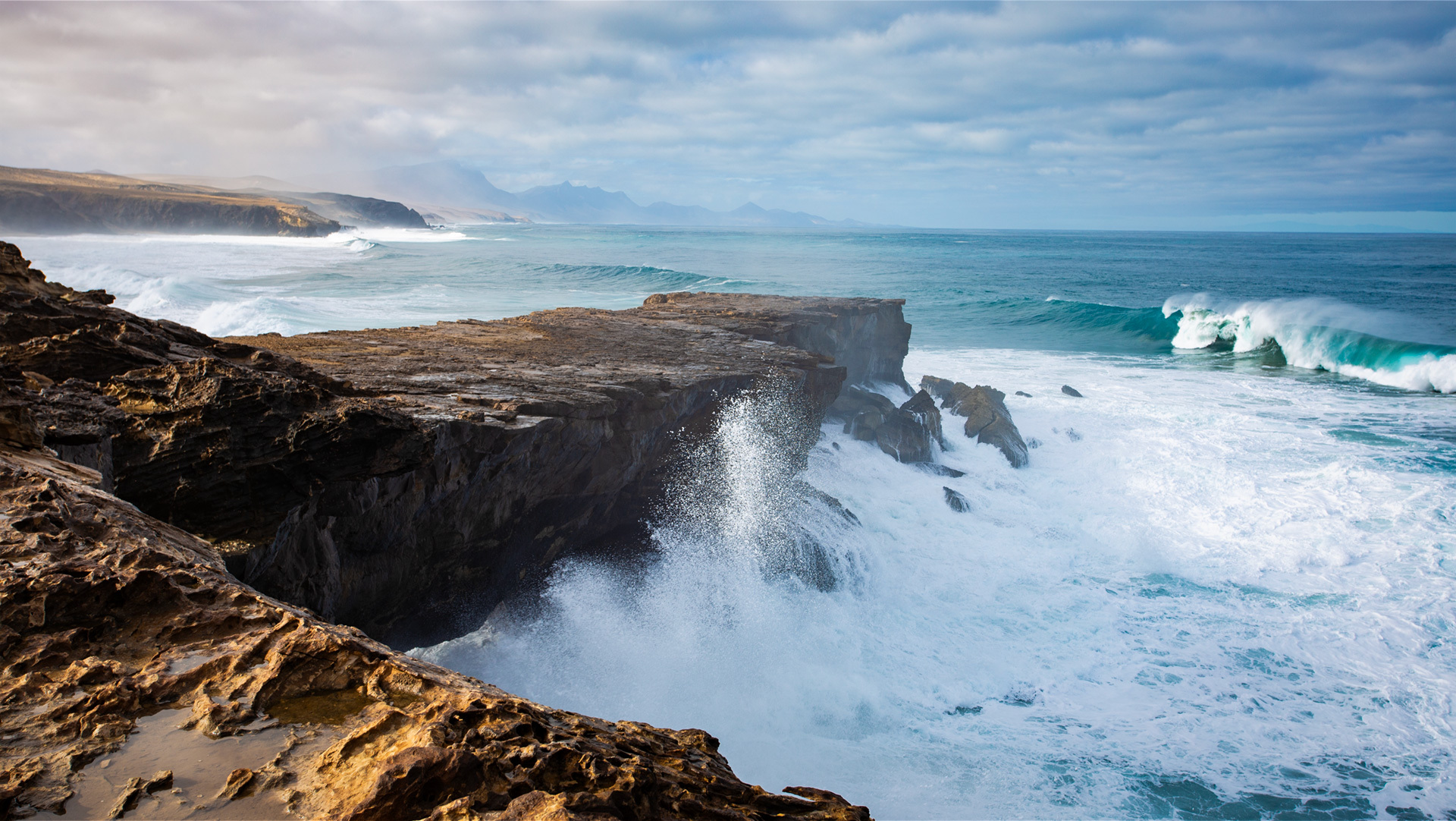
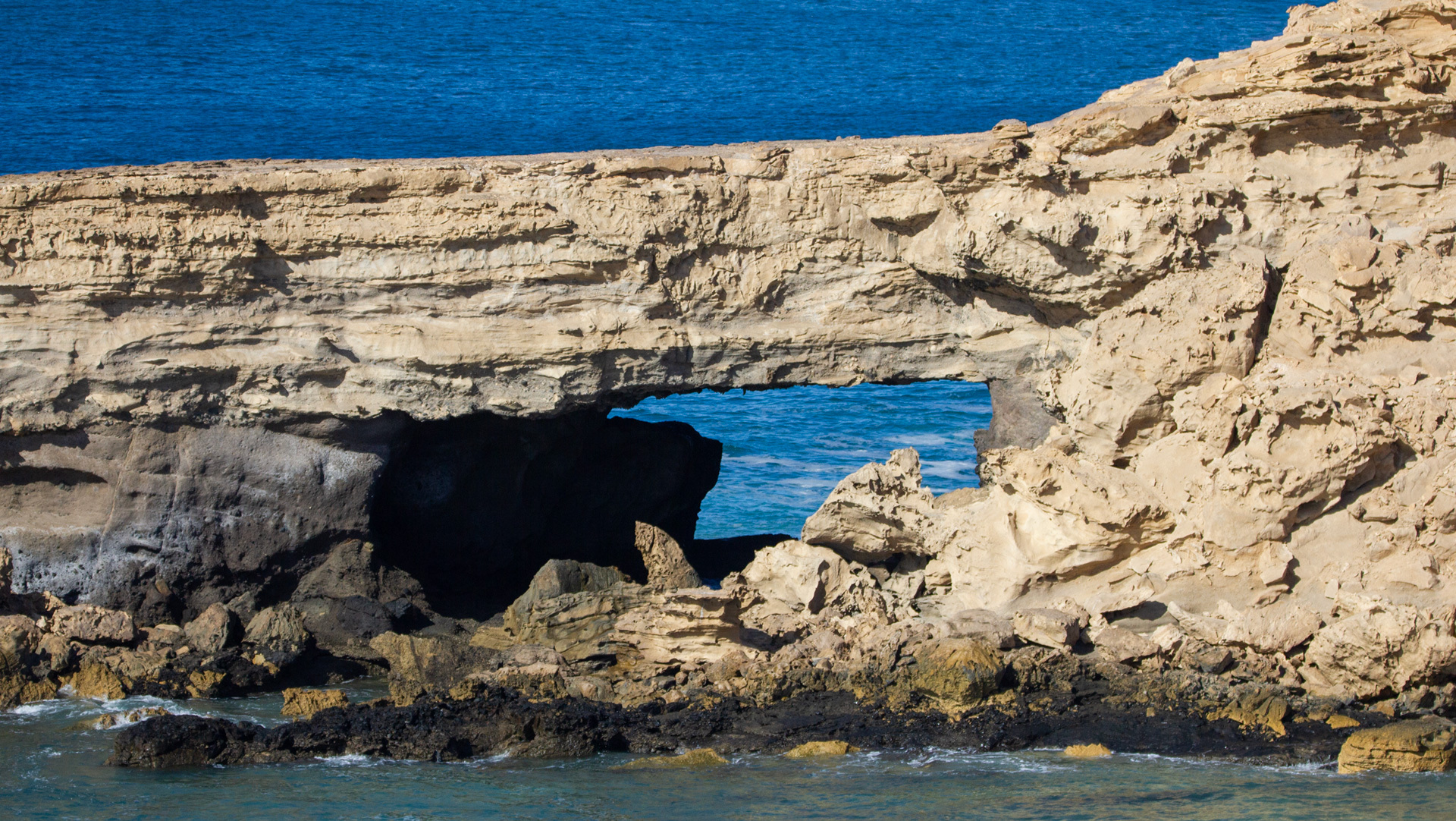
What wind and waves have carved from the soft limestone is breathtaking: overhangs, channels, smooth surfaces and the spectacular natural rock arch of Fuerteventura, formed through millennia of erosion. Fuerteventura’s cliff coast reveals itself here in full force – no railings, no taming, only the raw stone and the sea.
Far Views Across the Atlantic
From the Punta de Guadalupe viewpoint the gaze sweeps far across the open Atlantic, over nearby sandy beaches and on to the distant peaks of the Jandía mountains. In heavy seas, waves crash with full force against the cliff and hurl white spray metres into the air – a spectacle of nature that captivates photographers and nature lovers alike.
When the sun sinks in the west and bathes the limestone in orange and gold, Punta de Guadalupe ranks among the finest sunset viewpoints on Fuerteventura. A picture no camera can fully capture.
Safety note: The rock platform is easy to walk on, but the edges are unsecured. In heavy swell and onshore winds, sufficient distance from the cliff edge must be maintained at all times. The nature here is beautiful – and it demands respect.
Barbary ground squirrels by the wayside
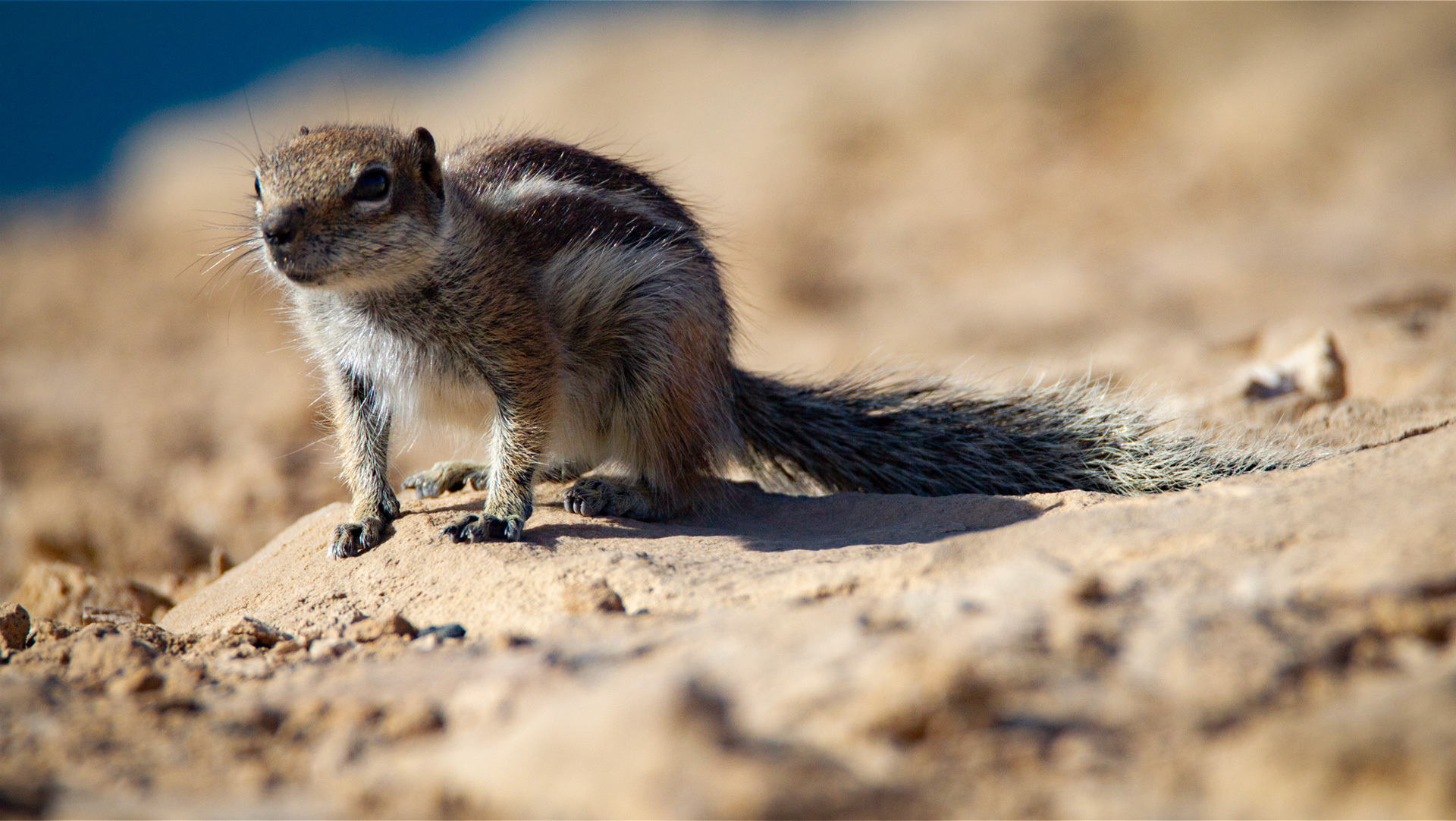
Those who wander quietly through the surroundings of Punta de Guadalupe will soon encounter another highlight: the nimble Barbary ground squirrels of Fuerteventura. These rodents, originally from North Africa, have adapted perfectly to the harsh climate and can often be spotted around the cliff – lively, inquisitive and utterly unfazed by the wind.
La Pared – Small Village, Excellent Base
At the northern end of the Istmo de la Pared lies the village of the same name, La Pared Fuerteventura – quiet, tranquil, mainly inhabited by locals. No large hotels, no shopping arcades. A few bungalows and holiday homes, a restaurant with sea views, a surf school. Here, Fuerteventura is still as it once was.
Walking from La Pared – Spectacular Coastal Routes
For walkers on Fuerteventura, La Pared is an ideal starting point. From here, routes lead through a landscape that no travel agent could have invented.
The moderate circular walk from La Pared of around 17 kilometres follows spectacular cliffs and wind-sculpted sandstone – a route that opens up new perspectives on Fuerteventura’s coastal landscape with every step. Some steep sections demand fitness, but reward you with views that linger long afterwards.
Another great route is the walk from La Pared to Playa Agua Liques – with impressive cliffs and the constant sound of the sea as your companion.
GR-131 – The Long-Distance Trail
Those who want even more can join the 7th stage of the GR-131 Fuerteventura in La Pared. This long-distance trail leads from here through Casas del Risco del Paso all the way to Morro Jable – largely through the Parque Natural de Jandía, past lava formations, rugged coastlines and the open sea. It is a route you walk not only with your legs, but with all your senses.
Getting to La Pared
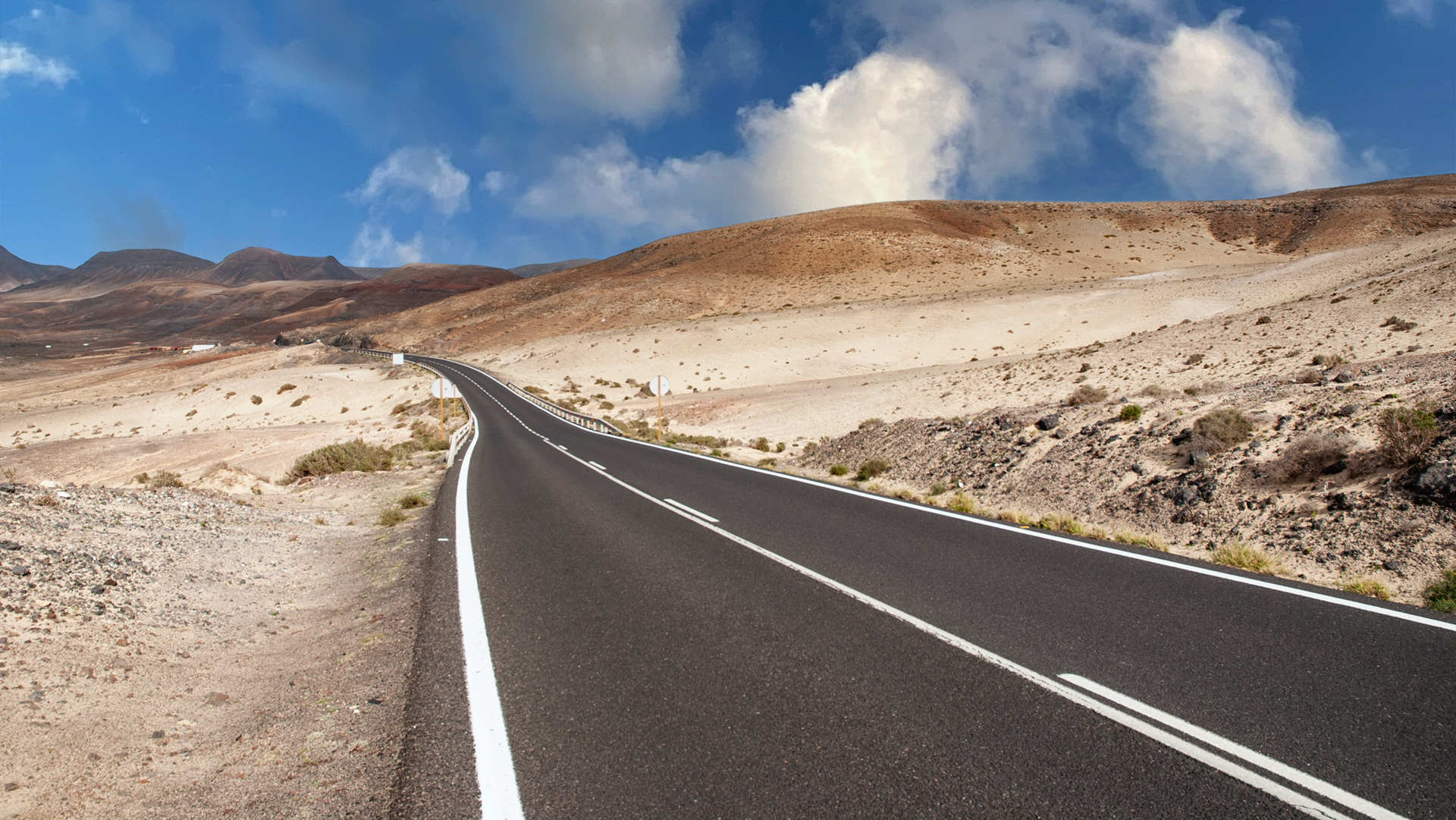
Coming from the west coast, take the FV-605 road directly into the village. Coming from the east coast, follow the FV-2 southwards and turn west towards La Pared approximately 1–2 kilometres before Costa Calma. Costa Calma itself also makes a good base for exploring the isthmus.
Conclusion: The Istmo de la Pared – Fuerteventura’s Quiet Centre
The Istmo de la Pared is not a place for sun loungers and pool bars. It is a place for those who truly want to see landscape – who want to feel the wind, watch the dunes migrate, encounter a Houbara Bustard, stand on a cliff and understand what Fuerteventura really is.
This narrow waist of sand, stone and wind is the heartpiece of an island shaped by the trade winds for millennia. You only have to go there – and let yourself drift, like the sand.